


Facial Contour 3-Point Surgery: Procedure Details and Downtime | Who Is Not a Good Candidate

The "facial contour 3-point" surgery directly approaches 3 areas of bone to balance the overall facial contour.
Even if you are interested in this surgery, many people feel anxious about the downtime or wonder "Is this really right for me?"
In this article, Kai Clinic Tokyo—which has helped countless patients achieve their ideal beauty—explains in detail the specific content of the facial contour 3-point surgery, its downtime, and the characteristics of those who are and are not suited for it.
What is Facial Contour 3-Point Surgery?
Facial contour 3-point surgery is a general term for surgeries that directly approach the 3 areas of bone—"jaw," "cheeks," and "chin (mentum)"—to reshape the facial contour.
By combining the following 3 surgeries, a small-face effect can be expected.
- Mandibular Angle Reduction (Jaw Shaving)
- Cheekbone Osteotomy
- Genioplasty (Chin Surgery)
Surgical Details of Facial Contour 3-Point Surgery
The facial contour 3-point surgery is performed by combining three procedures.
Here, we explain the specific details of each surgery.
Mandibular Angle Reduction (Jaw Shaving)
Mandibular angle reduction (jaw shaving) is a surgery that shaves down and removes the "mandibular angle (jaw)" bone, which causes a wide or angular facial appearance.
Rather than simply cutting off the corner, combining it with "outer cortex resection" to reduce bone thickness allows you to slim the width of the face when viewed from the front, creating a sharper impression.
Cheekbone Osteotomy
Cheekbone osteotomy is a surgery that cuts the cheekbones protruding forward (cheekbone body) or flaring outward (arch), moves them inward, and fixes them in place.
Since the facial width is physically reduced, the bony, angular appearance disappears, aiming for a softer and more refined facial look.
Genioplasty (Chin Surgery)
Genioplasty (chin surgery) is a surgery that cuts the chin bone and reshapes it by moving it forward/backward or up/down, or by narrowing its width.
Not only narrowing or shortening the chin tip, but also adjusting the front-to-back position to achieve the ideal balance for each patient is an expected benefit.
Who is and is Not Suited for Facial Contour 3-Point Surgery
Facial contour 3-point surgery is not necessarily suited for everyone seeking a smaller face.
Who is Suited for Facial Contour 3-Point Surgery
The following types of people are more likely to feel the effects of facial contour 3-point surgery.
- Those with a large bone structure who have reached the limits of self-care or minor cosmetic procedures:
Cases where "bone protrusion" cannot be resolved by subcutaneous fat removal or jaw Botox (muscle) alone. - Those who want to fundamentally reduce the overall facial space:
People with a wide area from the eyes outward, or a large area from the mouth down to the chin tip, will find that making the bones smaller helps their features stand out.
Who is Not Suited
The following types of people are advised to make a careful judgment regarding facial contour 3-point surgery.
- Those with significant sagging:
Because bone also serves as a support (foundation) for the skin, reducing the foundation may cause the existing skin to become excess, increasing the risk of accentuating sagging. In such cases, it is strongly recommended to combine a lift procedure such as a thread lift or incisional face lift. - Those whose cause is only "fat" or "muscle":
If the reason the face appears large is due to fat thickness or muscle development (such as teeth clenching), bone reduction may not be necessary. It is important to first receive a diagnosis and determine the appropriate indication. - Those with unrealistic ideals:
Important nerves and blood vessels run through the bone, and there is a "physical limit" to how safely the bone can be reduced. This procedure is not suitable for those who ignore risks and seek changes beyond those limits.
Downtime Guidelines and Risks of the 3-Point Contour Procedure
Many people are concerned about downtime with the 3-point contour procedure, as it directly addresses the bone.
Here we explain the downtime guidelines for the 3-point contour procedure, as well as the possible risks involved.
Downtime Guidelines for the 3-Point Contour Procedure
The downtime guidelines for small face and contour contouring through jaw, cheekbone, and chin bone surgery are as follows.
- 2–3 days after surgery: The period when swelling and bruising are most pronounced
- Up to 2 weeks: Symptoms gradually subside; you can appear in public
- Up to 3 months: Complete resolution
Guidelines for Returning to Work
For desk work with minimal physical strain, where understanding can be obtained from those around you who know about the surgery, the guideline for returning to work is approximately 2 days to 1 week after surgery.
On the other hand, for those in sales or customer-facing roles who wish to return without others noticing, approximately 1 month is the guideline.
※Even for desk work, if you do not want those around you to know, the same timeframe as for sales and customer-facing roles applies.
※If you are in an environment where wearing a mask is possible, it will be harder for others to notice.
Risks and Side Effects of the 3-Point Contour Procedure
The 3-point contour surgery carries the following risks and side effects.
| Swelling | Asymmetry | Bruising | Infection |
| Scarring | Hyperpigmentation | Foreign body reaction | Pain |
| Numbness | Sensory abnormality | Hair loss | Tissue necrosis |
| Visual disturbance (rare) | Facial nerve disorder | Allergic reaction | Complications such as shock reaction |
※The appearance of symptoms, progression, and recovery process vary from person to person.
Case Studies of the 3-Point Contour Procedure at KAI Clinic Tokyo
KAI Clinic Tokyo has performed many 3-point contour surgeries to date.
We introduce actual case studies of patients who underwent the 3-point contour procedure at our clinic.
3-Point Contour (Cheekbone Bone Cutting + V-Line Contouring)
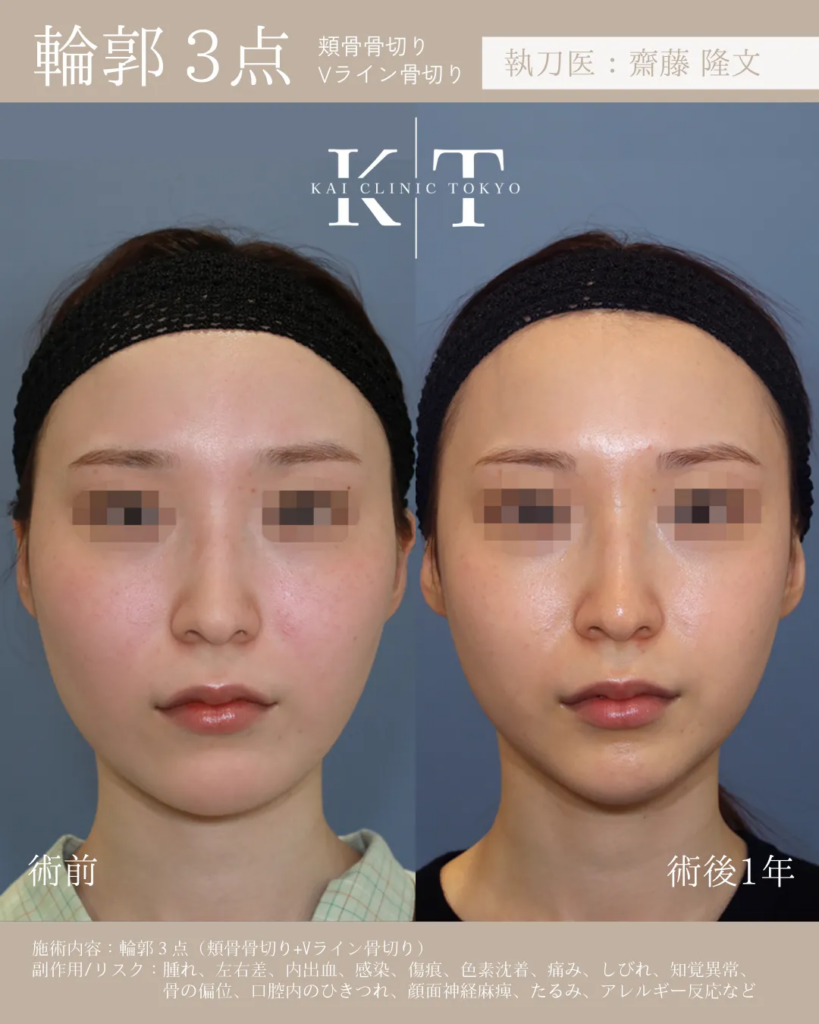
【Surgeon】
Takafumi Saito
【Treatment Details & Fee】
3-Point Contour (Cheekbone Bone Cutting + V-Line Contouring): ¥2,530,000
※A monitor program is also available, so please feel free to contact us.
【Risks & Side Effects】
Swelling, asymmetry, bruising, infection, scarring, hyperpigmentation, pain, numbness, sensory abnormality, bone displacement, intraoral tightness, facial nerve palsy, sagging, allergic reaction, etc.
3-Point Contour (Cheekbone Bone Cutting + V-Line Contouring) + Pelican Surgery
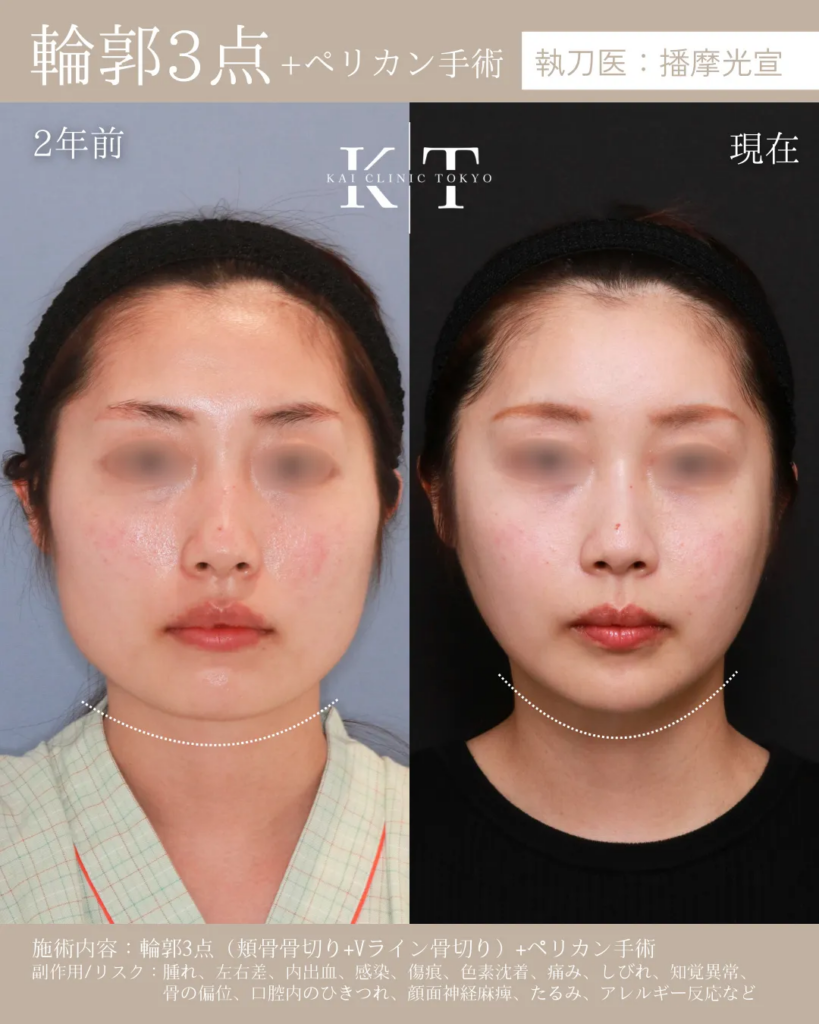
【Surgeon】
Mitsunobu Harima
【Treatment Details & Fee】
・3-Point Contour (2 years ago): ¥2,530,000
・Pelican Surgery (6 months ago): ¥1,100,000
【Risks & Side Effects】
Swelling, asymmetry, bruising, infection, scarring, hyperpigmentation, pain, numbness, sensory abnormality, bone displacement, intraoral tightness, facial nerve palsy, sagging, allergic reaction, etc.
How to Choose a Clinic to Avoid Regrets with the 3-Point Contour Procedure
The 3-point contour procedure is a surgery that cannot be reversed once performed, so it is important to choose your clinic carefully.
To avoid regrets with the 3-point contour procedure, make sure you understand the key points for choosing a clinic.
Extensive Surgical Experience in Bone Surgery and Diversity of Cases
Not only the number of surgeries performed, but also be sure to confirm whether the clinic handles a wide range of cases, from individual procedures on the jaw, cheekbones, and chin to combined 3-point simultaneous surgeries.
When reviewing case photos, check not only the front view but also whether the profile and diagonal lines are smooth and whether any unnatural steps (secondary angles) have occurred, examining the details of the results carefully.
Reliable Skills from a Plastic Surgery Specialist and 3D Simulation
Directly approaching the facial bones requires an exceptionally high level of skill.
Whether a "plastic surgery specialist" who has thorough anatomical knowledge of the facial bone structure, muscles, nerves, and blood vessel pathways performs the surgery is an important point in choosing a clinic.
Additionally, it is also important to check whether the clinic has the equipment to predict and plan postoperative outcomes using 3D simulation with CT imaging.
Whether Risks and Limitations Are Explained Transparently
Each person's facial bone structure is different, and there are limits to how much bone can be shaved or cut.
Therefore, choose a clinic where doctors clearly explain the limitations of each patient's bone structure, risks such as nerve palsy, and the difficulty of the downtime period, including the disadvantages.
By resolving any doubts or anxieties during a pre-operative consultation and choosing a clinic where you can discuss everything to your satisfaction, you can prevent post-operative regret of "this isn't what I expected."
If You Are Considering the 3-Point Facial Contouring, Please Consult Kai Clinic Tokyo
With the 3-point facial contouring procedure, the balance of your face after surgery is extremely important.
At Kai Clinic Tokyo, rather than simply making the face smaller, our experienced and accomplished plastic surgery specialists assess and design a proposal based on the overall balance of your entire face.
In addition, our care does not end with surgery — we have a comprehensive aftercare system in place so that you can consult us at any time about concerns or anxieties during the downtime period.
"I want to resolve my facial insecurities with the 3-point facial contouring."
"I want to achieve a well-balanced facial contour."
If you have such concerns, please feel free to consult our clinic at any time.
Our doctors, equipped with both technical skill and knowledge, will provide thorough consultations and assist you in achieving the beauty you are aiming for.
Summary
The "3-point facial contouring" directly approaches three areas of bone to reshape the facial contour.
However, the 3-point facial contouring is not necessarily suitable for everyone, and it is important to confirm each individual's bone structure and choose the most appropriate treatment accordingly.
At Kai Clinic Tokyo, we first assess the condition of your face during a consultation, and then propose treatments — including the 3-point facial contouring — to help you achieve your ideal facial contour.
"I want to refine my facial contour and create a sharper impression."
"I want to know which method is right for me."
If this sounds like you, please feel free to consult Kai Clinic Tokyo.
Supervisor of This Article
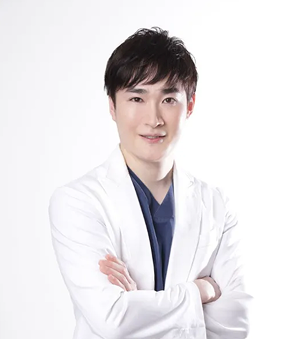
Director Mitsunobu Harima
Academic Memberships
Japan Society of Plastic and Reconstructive Surgery
Japan Society of Aesthetic Plastic Surgery (JSAPS)
Titles & Qualifications
Board-Certified Specialist, Japan Society of Plastic and Reconstructive Surgery
Board-Certified Specialist, Japan Society of Aesthetic Plastic Surgery (JSAPS)
Career
-
Graduated from the Faculty of Medicine, University of Tokyo
-
Nadogaya Hospital — Initial Resident Physician
-
University of Tokyo Hospital — Department of Plastic & Aesthetic Surgery, Special Clinical Physician
-
University of Tokyo Hospital — Department of Plastic & Aesthetic Surgery, Assistant Professor
-
Kanto Central Hospital — Department of Plastic Surgery
-
Tokyo Metropolitan Police Hospital — Department of Plastic & Aesthetic Surgery
-
Kato Clinic ANNEX — Appointed Director
-
Kai Clinic Tokyo — Appointed Director