



Causes of a Large-Looking Face | Limits of Self-Care and Recommended Cosmetic Treatments

Many people who are concerned about the size of their face look up self-care methods to address it.
While there are certainly various self-care methods available on the internet, it is important to note that they have real limitations and may in some cases cause adverse effects.
In this article, we thoroughly explain why your face may look large in the first place, as well as the causes and the reasons why self-care has its limits.
We also introduce the cosmetic medical treatments that Kai Clinic Tokyo recommends for those concerned about the size of their face, so if you want to resolve your complex about facial size, please use this as a reference.
Main causes of a large-looking face
Behind a face that looks large, there are mainly four factors: "bone structure," "muscles," "fat," and "placement."
First, we explain the causes of why your face may appear large.
Genetic "bone structure" protrusion
If the jaw angle (mandibular angle) protrudes outward or the cheekbones jut out to the sides or forward from birth, the width of the face is emphasized and the face appears physically larger.
Development of muscles (masseter)
For those who habitually clench or grind their teeth, the "masseter muscle" located at the jaw area becomes overdeveloped and bulges out.
As a result, the facial contour takes on a home-plate shape, making the face appear larger.
Fat accumulation and "sagging"
Fat in the deep layer of the cheeks (buccal fat), subcutaneous fat, age-related "sagging," and a "double chin" caused by fat under the jaw are also causes that blur the boundary between the face and neck, making the face appear larger.
Facial feature placement and excess "negative space"
Even if the facial area itself is small, if the features are clustered toward the center or the nose is low and the face is flat, the surrounding "negative space" stands out and the face can look visually larger.
In addition, if the mid-face or philtrum (below the nose) is long, the face may give an elongated impression.
The "balance" standard for a large-looking face
Now that we have explained the causes of why a face can look large, some of you may be wondering, "From what point is a face considered large?"
Here we introduce the general standards for facial size balance.
The "Golden Ratio" of a Beautiful Face
The ideal facial balance is commonly defined as a ratio of 1:1:1 among the hairline to brow, brow to nose tip, and nose tip to chin.
Therefore, in cases such as the following, the face may appear larger.
- The visual weight is concentrated in the upper face
- There is excessive space below the eyes
- The area below the nose and the chin appear long
- The face lacks width
- The position of facial volume is too high
The Length of the "Mid-Face" and "Philtrum"
The length of the mid-face and philtrum is also closely related to how large the face appears.
As a general guideline, if the philtrum is 2 cm or longer, or if the base of the nose (alar base) is sunken making the face look flat, the gaze is drawn downward, emphasizing the "empty space" on the face.
The Limits and Risks of Self-Care for a Large Face
As mentioned at the beginning, the internet is full of self-care information such as small-face massage techniques.
However, self-care not only has its limits but also carries hidden risks of causing adverse effects.
Sagging Caused by Damage to Tissue Around the Ligaments
Massaging with strong force can stretch or damage the soft tissue around the ligaments that support the foundation of the face.
Once loosened, this tissue cannot return to its original state on its own, carrying the risk of causing serious "overall facial sagging" in the future.
Counterproductive Effects and Wrinkles from Small-Face Training (Facial Muscle Exercises)
There is information suggesting that "training the facial muscles will tone the face."
However, such an approach carries the following risks that require caution.
- Development of the jaw:
Exercises that excessively train the muscles around the jaw (such as clenching hard) can develop the masseter muscle, potentially promoting a "home plate"-shaped jawline with prominent angles instead. - Formation of expression wrinkles:
Exercises that vigorously move specific areas can deeply engrave wrinkles between the brows, at the corners of the eyes, and around the mouth, and the risk of appearing "older" may outweigh any small-face effect.
Bone Cannot Be Moved by "Small-Face Correction"
If the cause of a large-looking face lies in the bone structure, self-care cannot improve it.
Medically, massage cannot move the skeletal structure of an adult, and fundamental improvement of bone structure requires a surgical approach.
Recommended Cosmetic Medical Treatments at KAI Clinic Tokyo for Those with a Large Face
At KAI Clinic Tokyo, where we help each patient resolve their individual beauty concerns, we offer cosmetic medical treatments for those who have a complex about the size of their face.
"Bone Contouring Surgery" to Reshape the Face from the Skeletal Level
For those who wish to fundamentally improve facial size, we propose the following bone contouring surgery approaches.
- Three-point contouring (jaw angle, cheekbones, chin):
Protruding bones are adjusted to the millimeter to create a smooth V-line. - Double jaw surgery (Le Fort I + SSRO):
Surgery that physically shortens the mid-face and fundamentally changes facial proportions.
When Reshaping Features to Fill in "Empty Space"
When the cause lies in the balance of the mid-face or philtrum length, we propose methods to refine features with the following procedures.
- Noble surgery (alar base augmentation):
Elevates the base of the nose to eliminate a sunken appearance. The resulting three-dimensionality (depth) softens and reduces the prominence of cheek space and vertical elongation. - Philtrum shortening (lip lift):
Shortens the area below the nose, eliminating a stretched appearance and guiding the face toward a well-balanced look.
Case Studies at KAI Clinic Tokyo | Real Examples of Achieving a Smaller-Looking Face
Here we introduce cases of patients who actually improved the size of their face at our clinic.
Full Face
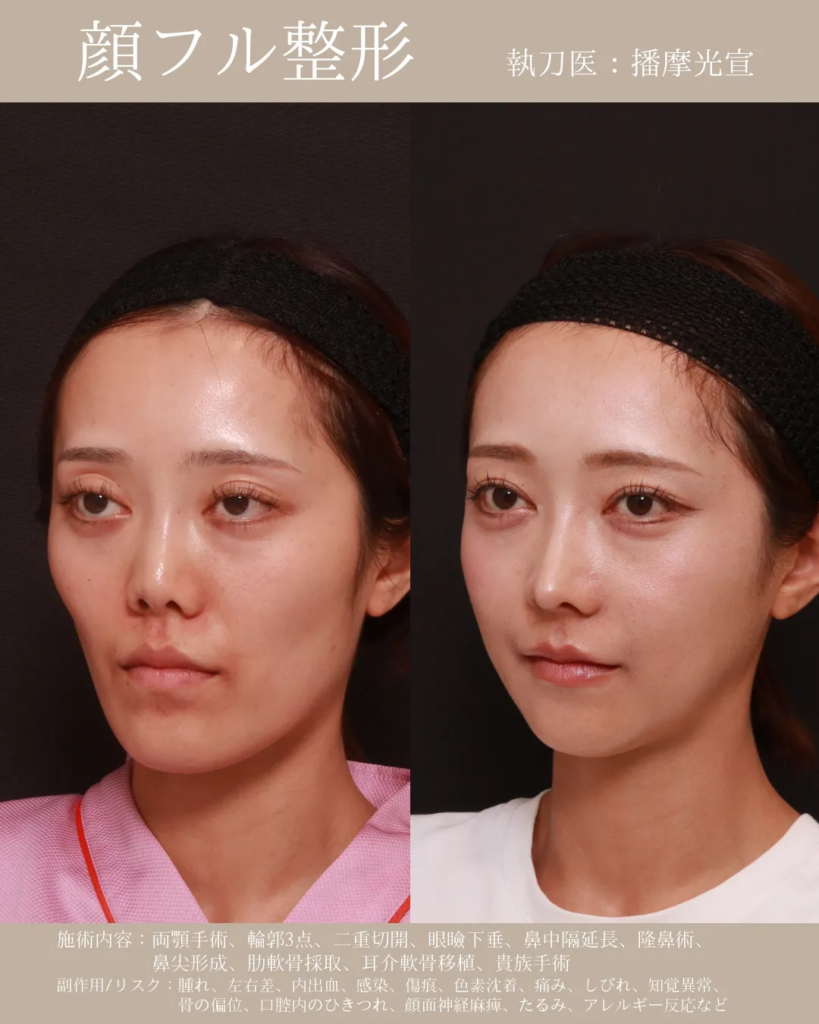
[Surgeon]
Mitsunobu Harima
[Procedure Details & Fees]
Double Jaw Surgery: ¥2,970,000 / Three-Point Contouring: ¥2,530,000 / Ptosis Correction + Double Eyelid Surgery: ¥770,000 / Septal Extension: ¥495,000 / Rhinoplasty (Implant): ¥330,000 / Nasal Tip Plasty: ¥330,000 / Costal Cartilage Harvesting: ¥660,000 / Auricular Cartilage Graft: ¥165,000 / Noble Surgery: ¥275,000
[Risks & Side Effects]
Swelling, asymmetry, bruising, infection, scarring, hyperpigmentation, pain, numbness, sensory abnormalities, bone displacement, intraoral tightness, facial nerve palsy, sagging, allergic reactions, etc.
Double Jaw Surgery + Four-Point Contouring
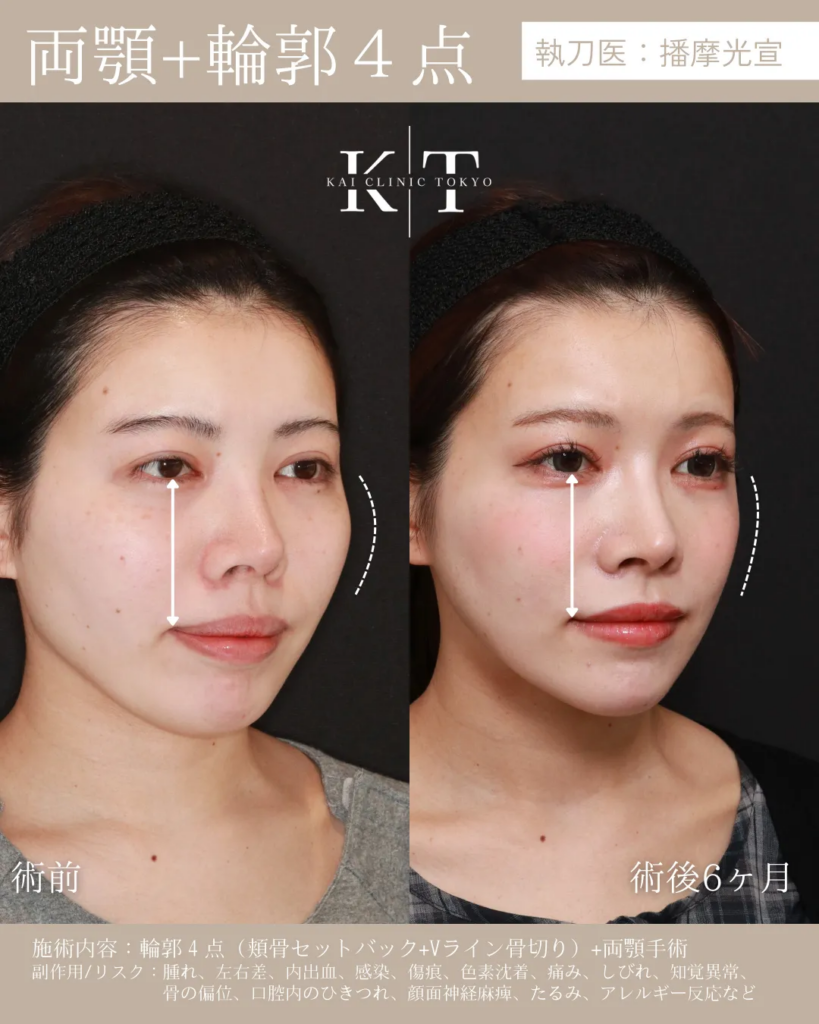
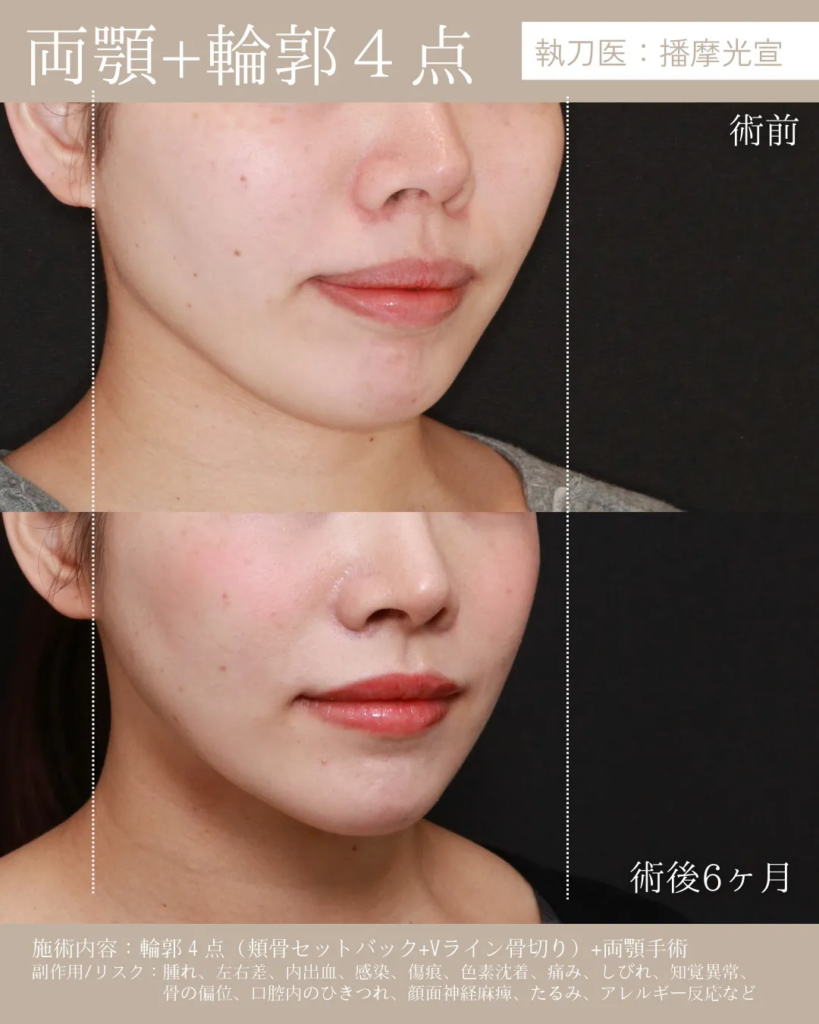
【Surgeon】
Mitsunobu Harima
【Treatment Details】
Bimaxillary surgery (upper and lower jaw osteotomy): ¥2,970,000 / Facial contouring 4-point (cheekbone setback + V-line osteotomy): ¥2,970,000
【Risks & Side Effects】
Swelling, asymmetry, bruising, infection, scarring, hyperpigmentation, pain, numbness, sensory abnormalities, bone displacement, intraoral contracture, facial nerve palsy, sagging, allergic reactions, etc.
Facial Contouring 4-Point (Cheekbone Setback + V-Line Formation)
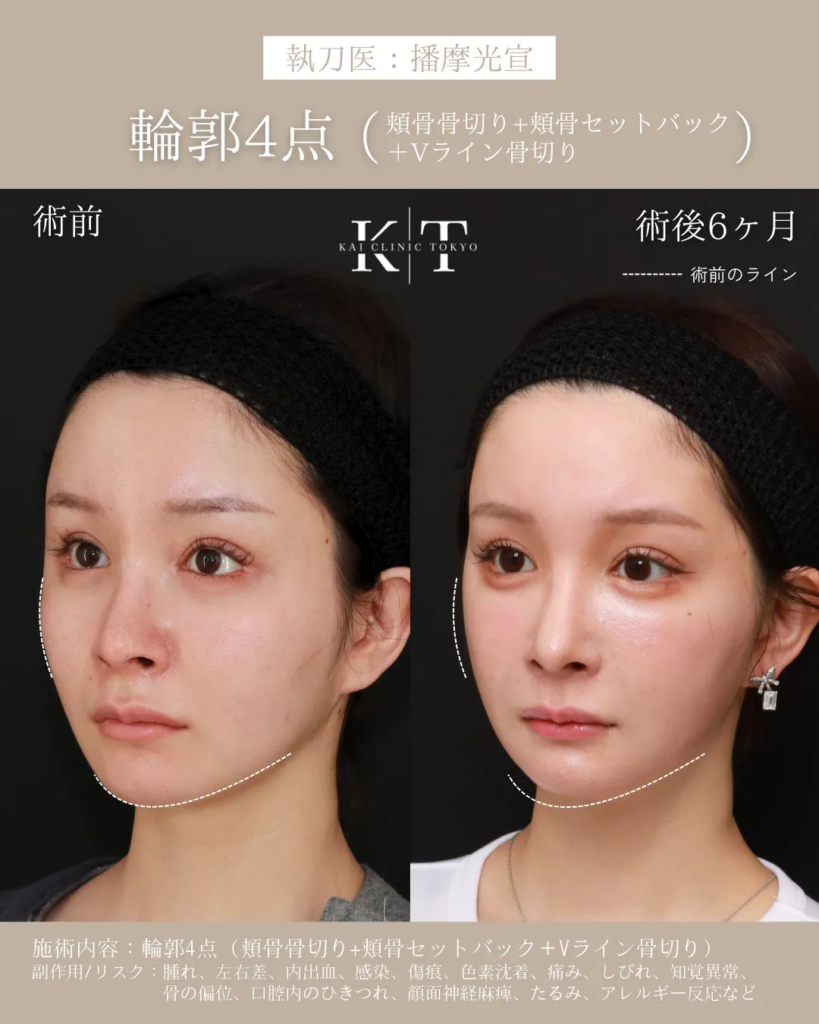
【Surgeon】
Mitsunobu Harima
【Treatment Details】
Facial contouring 4-point (cheekbone setback + V-line formation): ¥2,970,000
※A monitor program is also available, so please feel free to consult us.
【Risks & Side Effects】
Swelling, asymmetry, bruising, infection, scarring, hyperpigmentation, pain, numbness, sensory abnormalities, bone displacement, intraoral contracture, facial nerve palsy, sagging, allergic reactions, etc.
Points to Note When Choosing a Clinic for Facial Contouring or Small Face Surgery
When it comes to facial contouring and small face surgery, choosing the right clinic is the key to achieving your ideal look.
Here are some points to keep in mind when selecting a clinic.
Is the Surgeon a Certified Plastic Surgery Specialist?
The face contains a dense concentration of important nerves and blood vessels.
For this reason, always confirm whether surgery will be performed by a certified plastic surgery specialist who has thorough knowledge of anatomy and can handle any complications that may arise.
Precise Simulation Using CT Imaging
Skeletal issues cannot be assessed from appearance alone.
Choose a clinic that performs CT scans, confirms bone structure in 3D, and then formulates an accurate surgical plan.
"Aftercare System" That Supports You Through Post-Surgery Concerns
Small face surgery, especially bone-cutting procedures, involves a long downtime, and there may be periods of anxiety due to post-surgical swelling and discomfort.
To help ease such post-surgical concerns even a little, confirm whether the clinic has a well-established aftercare system including the following.
- Comprehensive follow-up examinations:
Whether ongoing check-ups are provided at 1 week, 1 month, 3 months, and 6 months after surgery. - Emergency response:
Whether a contact system is in place for distressing symptoms that may arise at night or on holidays.
If You Are Concerned About Your Face Looking Large, Consult KAI Clinic Tokyo
If you have a complex about the size of your face, it can be disheartening every time you look in the mirror.
At KAI Clinic Tokyo, we listen carefully to each patient's concerns and, through thorough consultations, propose treatments aimed not merely at making the face smaller, but at achieving overall facial balance.
If you are thinking, "I want a smaller face so I can go through each day with confidence," please feel free to book a counseling session via our official LINE account.
Our experienced physicians, equipped with both knowledge and skill, will do their utmost to support you in achieving "beauty that is uniquely yours."
Summary
When you search online for ways to achieve a smaller face, you will find a variety of self-care methods.
However, when the cause lies in bone structure or the balance of facial features, it cannot be corrected on your own, and a surgical approach through cosmetic medicine is necessary.
At KAI Clinic Tokyo, we first clarify during the consultation "why the face appears large," and then propose treatments tailored to each individual patient.
We also have a thorough aftercare system in place, so you can consult us at any time about post-surgery concerns.
If you are looking to resolve your complex about the size of your face, please do not hesitate to contact our clinic.
Supervisor of this article

Director Mitsunobu Harima
Academic Societies
Japan Society of Plastic and Reconstructive Surgery
Japan Society of Aesthetic Plastic Surgery (JSAPS)
Titles & Qualifications
Board Certified Member of the Japan Society of Plastic and Reconstructive Surgery
Board Certified Member of the Japan Society of Aesthetic Plastic Surgery (JSAPS)
Career
-
Graduated from the Faculty of Medicine, University of Tokyo
-
Nadogaya Hospital – Resident Physician
-
University of Tokyo Hospital – Department of Plastic & Aesthetic Surgery, Special Assignment Clinician
-
University of Tokyo Hospital – Department of Plastic & Aesthetic Surgery, Assistant Professor
-
Kanto Central Hospital – Department of Plastic Surgery
-
Tokyo Metropolitan Police Hospital – Department of Plastic & Aesthetic Surgery
-
Kato Clinic ANNEX – Appointed Director
-
Kai Clinic Tokyo – Appointed Director