


What is a Nasal Prosthesis? Procedure Details, Risks, and Downtime Explained
Many people feel self-conscious about the flatness of their nose or the lack of definition in their nasal bridge every time they look in the mirror.
Nose prosthesis (rhinoplasty implant) is one of the representative procedures for adding height to the nasal bridge, but many people proceed without fully understanding the types, risks, and downtime involved.
In this article, we will explain in detail the procedure content and types of nose prosthesis, downtime, risks and side effects, differences from hyaluronic acid and autologous tissue, and how to choose a clinic so you won't regret your decision.
Basic Knowledge of Nose Prosthesis
Nose prosthesis is a procedure that uses an implant to shape the nasal bridge. Understanding how it works and what concerns it can address is the first step in considering the treatment.
Here, we introduce the basics of nose prosthesis and how it differs from other procedures.
What is a Nose Prosthesis?
A nose prosthesis is a procedure in which an artificial cartilage made of medical-grade silicone is inserted along the nose bridge to adjust the height and shape of the nose.
The goal is to create a clean, defined nose bridge by adding height from the nasal root to the nasal dorsum. However, results vary individually depending on bone structure and skin condition, and it is not always possible to reproduce the ideal shape exactly.
Additionally, as this is a surgical procedure, it involves risks and downtime. It is important to understand not only the benefits but also the precautions before considering the procedure.
Procedure Details for Nose Prosthesis
For prosthesis surgery alone to raise the nose bridge, the closed method—incising only the inside of the nostrils—is often used, with the characteristic that incisions are not visible from the outside.
The procedure generally involves detaching the periosteum at the nasal root to create a pocket for the prosthesis, inserting and adjusting the prosthesis, and then securing it with tape or a cast. Unlike hyaluronic acid, the prosthesis is not absorbed by the body, so long-lasting effects can be expected; however, the unique risks of inserting a foreign object and the need for a fixation period must be taken into consideration.
Note that in cases of combined surgery to also reshape the tip of the nose, the open method involving an incision at the nasal tip may be chosen.
Concerns That Can Be Addressed with a Prosthesis
Nose prosthesis is a procedure well-suited for concerns such as "my nose is low," "I want a defined nose bridge," or "I want more dimension in my profile."
On the other hand, concerns such as wanting a slimmer or higher nasal tip are generally considered difficult to address with a prosthesis alone.
In such cases, combining other procedures such as autologous tissue transplantation may be considered.
The appropriate method for your concerns varies depending on the condition and bone structure of your nose. A medical examination by a physician is necessary to determine the most suitable procedure.
Differences from Hyaluronic Acid and Autologous Tissue
Methods for adding height to the nose bridge include, in addition to nose prosthesis, hyaluronic acid injection and autologous tissue transplantation, each with different characteristics and downtime.
| Method | Details / Characteristics | Benefits | Downtime |
| Nose Prosthesis | A method used to add height to the nose bridge | ・Easy to stably add height to the nose bridge ・Semi-permanent results※ | Swelling and bruising are most noticeable in the first 1–2 weeks after surgery. A cast or tape fixation is required for approximately 3–7 days. It takes about 3 months for the incisions and tissue to fully settle. |
| Hyaluronic Acid Injection | A method of adding height to the nose bridge without a scalpel | ・Easy to add height with minimal effort ・Effects are temporary (1–2 years) | Almost none (bruising may rarely occur) |
| Autologous Tissue Transplantation | A method in which your own tissue (costal cartilage, fascia, dermal fat, etc.) is harvested and transplanted to the nose bridge | ・Extremely low risk of allergic or foreign body reactions since your own tissue is used ・Semi-permanent results once engrafted※ | Swelling and bruising are most noticeable in the first 1–2 weeks after surgery. A cast or tape fixation is required for approximately 3–7 days. It takes about 3 months for the incisions and tissue to fully settle. |
※However, changes due to aging and maintenance may be required in some cases.
When you also want to reshape the nasal tip, a combined approach—using a prosthesis to add height to the nose bridge and autologous tissue to shape the tip—is one option to consider.
In particular, autologous tissue is characterized by a relatively low risk of complications such as bacterial infection, since the patient's own tissue is used.
However, it is not possible to uniformly determine which method is superior; the most suitable approach varies depending on bone structure and desired results. We recommend first consulting with a physician before deciding on a course of action.
Types of Nose Prosthesis
Nose prostheses come in different shapes, with varying insertion ranges and appropriate uses.
Here, we introduce the characteristics of representative types and considerations for choosing a type.
Characteristics of the I-Type Prosthesis
The I-type prosthesis is characterized by a straight shape that raises the nose from the nasal root to just before the nasal tip, without being inserted into the tip itself.
It is considered to place relatively less burden on the skin at the nasal tip, and a shape that includes from the glabella to the nose bridge may also be selected.
However, results vary individually, and suitability differs depending on the condition of the nose, so a physician's examination is necessary to determine whether this shape is right for you.
Characteristics and Precautions of the L-Type Prosthesis
The L-type prosthesis has an L-shaped form that covers from the nasal root to the nasal tip, and has been characterized by its ability to add height all the way to the tip in a single procedure.
However, in recent years, there has been a growing trend toward choosing methods that use a prosthesis for the nose bridge and autologous tissue for the nasal tip, rather than an L-shaped prosthesis that covers all the way to the tip.
The L-shape has relatively often caused problems such as prosthesis shifting and the tip of the prosthesis showing through the skin, which is why KAI CLINIC TOKYO does not recommend it.
How to Choose a Shape and the Importance of Consulting a Doctor
The most suitable shape varies depending on where on the nose you want to add height, as well as your bone structure and skin condition.
In cases where nasal tip reshaping is needed, a prosthesis alone may not be sufficient, and combined use of autologous tissue grafting or septal extension may be considered.
Choosing a shape is difficult to decide on your own, so it is important to consult with a doctor to determine which method is right for you.
Downtime for Nasal Prosthesis Surgery
Because nasal prosthesis surgery involves an operation, downtime such as swelling and bruising will occur after the procedure.
Here we introduce a general timeline for post-operative recovery and key points to be mindful of during downtime.
Post-Operative Progress and Expected Symptoms
After nasal prosthesis surgery, pain, swelling, and bruising typically peak around 2 to 3 days post-operation, then gradually subside.
Significant swelling and bruising generally become less noticeable within 1 to 2 weeks after surgery, and it typically takes around 3 to 4 weeks to reach a natural state where others will not notice. After that, it takes approximately 3 months for the incisions and surrounding tissue to fully settle and for the final result to be achieved.
The speed of recovery and the extent of symptoms vary from person to person and depend on individual constitution and the details of the procedure. If you have any concerning symptoms, it is important not to make your own judgment but to check with your doctor.
How to Spend Your Downtime and Precautions
During the downtime period, it is important to keep the treated area dry during the fixation period and to avoid rubbing or touching it forcefully.
The timing for resuming face washing, makeup, and bathing varies depending on the procedure, so please follow your doctor's instructions. You will also need to refrain from alcohol, smoking, strenuous exercise, and strong impact to the nose for a certain period of time.
Following these precautions is important for stabilizing your post-operative recovery and maintaining your results. Therefore, please follow your doctor's instructions before and after the procedure, and be sure to consult your doctor if you are unsure about anything.
Risks and Side Effects of Nasal Prosthesis Surgery
Because nasal prosthesis surgery involves inserting an artificial implant, there are precautions specific to prostheses in addition to the general risks associated with surgery.
Here we explain the reactions that may occur after surgery and the points to keep in mind over the long term.
Risks and Side Effects Associated with Surgery
After nasal prosthesis surgery, the following reactions associated with the procedure may occur.
| Swelling | Bruising | Pain | Infection |
| Edema | Redness | Scarring | — |
Many of these are expected to subside over time, but the severity and duration of symptoms vary from person to person.
In particular, symptoms such as infection may require prompt attention, so if you notice any concerning symptoms, it is important not to make your own judgment but to consult your doctor.
Risks Specific to Prostheses
Because a prosthesis involves inserting an artificial implant, there is a possibility of the prosthesis shifting before it becomes fixed, its outline becoming visible through the skin, or a sensation of a foreign body.
Additionally, compared to autologous tissue, prostheses are considered more prone to infection, and it is sometimes noted that prostheses shaped to cover the nasal tip carry a risk of protrusion through the skin.
Furthermore, the final result may sometimes feel different from what was desired. With these risks in mind, it is important to thoroughly discuss the procedure with your doctor before deciding to proceed.
Changes Over Time and Replacement or Removal
With long-term implantation, the surrounding tissue may calcify and cause irregularities, or the outline of the prosthesis may become more visible with aging.
On the other hand, because prostheses are not absorbed by the body, removal or replacement can be performed as needed.
It is important to consider the procedure from a long-term perspective, including the possibility of future maintenance.
If you are concerned about changes over time, we recommend receiving regular check-ups from your doctor to monitor your progress.
Who Is and Is Not a Good Candidate for Nasal Implants
Whether nasal implants are right for you depends on your concerns, the condition of your nose, and whether you can secure adequate downtime.
Here we describe the characteristics of those who are good candidates for nasal implants, those who should consult carefully before proceeding, and an alternative option called "autologous tissue rhinoplasty."
Characteristics of Good Candidates
Nasal implants are often considered by those who wish to add height from the nasal root to the nasal dorsum and achieve a well-defined nose bridge.
They are particularly suited to those who want more three-dimensionality in their profile or who feel their nose bridge lacks definition. For those with a low glabella or nasal root, a shape that encompasses the area from the glabella to the nose bridge may be appropriate.
However, since the suitable shape and indications vary depending on the condition of the nose, a physician's assessment is required to determine whether this procedure is right for you.
Characteristics of Those Who Should Consult Carefully
Concerns such as wanting a slimmer or higher nasal tip are generally difficult to address with implants alone.
In such cases, other procedures such as autologous tissue transplantation may be considered.
In addition, the following individuals should consult carefully: those with thin skin at the nasal tip, those with a history of nasal surgery, those at high risk of infection, and those who cannot secure sufficient downtime.
That said, meeting any of these criteria does not necessarily mean the procedure cannot be performed. It is important to first consult a physician to confirm what approach is appropriate for your condition.
An Alternative to Nasal Implants: "Autologous Tissue Rhinoplasty"
Autologous tissue rhinoplasty is an alternative to nasal implants.
Autologous tissue rhinoplasty is a procedure in which the patient's own tissue is transplanted to add height to the nose bridge, most commonly using costal cartilage from the chest.
Because the patient's own tissue is used, the texture and appearance tend to blend naturally, and foreign body reactions and rejection are less likely to occur. This makes it one option worth considering for those who wish to avoid risks associated with artificial materials such as implants.
However, since autologous tissue rhinoplasty is still a surgical procedure, it involves downtime and risks such as swelling and bruising. Whether implants or autologous tissue is more suitable depends on bone structure and desired results, and cannot be determined uniformly.
KAI CLINIC TOKYOtakes into account the condition of your nose and your wishes, explains the characteristics of both implants and autologous tissue, and proposes the method best suited to each individual.
If you are unsure which option is right for you, please feel free to consult us at a counseling session.
Choosing a Clinic to Avoid Regret After Nose Surgery
Since the results and approach to risks vary from clinic to clinic, it is important to evaluate your options carefully before undergoing nose surgery.
To avoid regret, make sure to confirm in advance which method is appropriate for your concerns, as well as the risks and side effects, downtime, total cost, and how the clinic handles aftercare, revisions, and implant removal.
Nasal implants also carry risks such as displacement, infection, and changes over time, and removal or replacement may need to be considered if necessary.
If a clinic takes the time to explain not only the benefits but also the risks and costs, you are less likely to feel a gap between your expectations and the outcome after the procedure.
In addition, indications, risks, costs, and downtime vary for each individual. Do not hesitate to ask the physician any questions you have, and proceed only after you are fully satisfied—this is key to preventing regret.
KAI CLINIC TOKYO Nose Surgery Case Studies
KAI CLINIC TOKYOoffers cosmetic medical approaches for those with concerns about their nose.
Here we introduce some nose surgery case studies from our clinic.
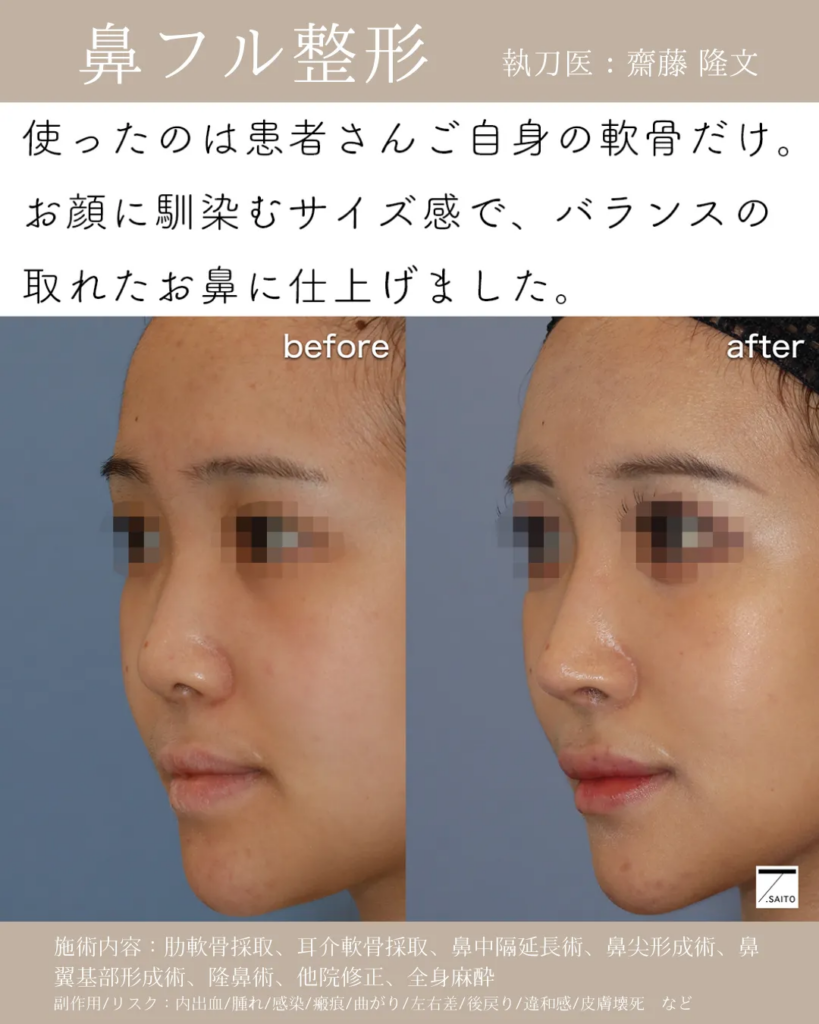
Full Nose Package [Female]
【Surgeon】
Takafumi Saito
【Procedure Details】
Costal cartilage harvesting: ¥660,000, Auricular cartilage harvesting: ¥165,000, Septum extension: ¥495,000, Nasal tip plasty: ¥330,000, Alar base reduction (aristocrat surgery): ¥275,000, Rhinoplasty (augmentation): ¥330,000, Revision of previous clinic's surgery: ¥220,000
【Risks / Side Effects】
Bruising, swelling, infection, scarring, deviation, asymmetry, regression, discomfort, skin necrosis, etc.
If you are considering nose surgery, please consult KAI CLINIC TOKYO
Nose prosthesis is a procedure that can effectively add height to the nose bridge, but expert judgment is essential to determine the best approach for you, including nose tip shaping and risk management.
The most suitable procedure varies from person to person depending on the condition of the nose, bone structure, and desired results. Even if you are unsure whether a prosthesis or autologous tissue is right for you, the first step is to accurately understand your current condition.
At KAI CLINIC TOKYO, we carefully explain the characteristics, risks, downtime, and estimated costs of both prosthesis and autologous tissue options based on your nose condition and wishes, and propose a treatment plan tailored to each individual.
"I want a more defined nose bridge."
"I don't know which method suits me."
If you have concerns like these, please feel free to consult our clinic.
Summary
Nose prosthesis is a procedure that can effectively add height to the nose bridge, but it is difficult to address nose tip shaping, and combining it with autologous tissue transplantation may be considered.
The most suitable method varies depending on bone structure and desired results, and understanding the risks and downtime is essential, so it is important to first consult a doctor to determine the best approach for you.
At KAI CLINIC TOKYO, we offer proposals that take into account the characteristics of both prosthesis and autologous tissue options.
"I want a more defined nose bridge."
"I want to know which method suits me."
If you have concerns like these, please feel free to consult our clinic.
Supervisor of this article

Director Mitsunobu Harima
Academic Societies
Japan Society of Plastic and Reconstructive Surgery
Japan Society of Aesthetic Plastic Surgery (JSAPS)
Titles & Qualifications
Board Certified Member of the Japan Society of Plastic and Reconstructive Surgery
Board Certified Member of the Japan Society of Aesthetic Plastic Surgery (JSAPS)
Career
-
Graduated from the Faculty of Medicine, University of Tokyo
-
Nado-ga-ya Hospital, Initial Resident Physician
-
University of Tokyo Hospital, Department of Plastic & Aesthetic Surgery, Special Assignment Clinical Physician
-
University of Tokyo Hospital, Department of Plastic & Aesthetic Surgery, Assistant Professor
-
Kanto Central Hospital, Department of Plastic Surgery
-
Tokyo Metropolitan Police Hospital, Department of Plastic & Aesthetic Surgery
-
Appointed Director of Kato Clinic ANNEX
-
KAI CLINIC TOKYO Appointed Director