


Types of Jaw Reduction Surgery | Procedures by Cause and How to Choose a Clinic
Every time you look in the mirror, you may notice the contour of your face or the prominence of your jaw.
Many people dream of a slimmer facial line but are not sure what is actually causing their prominent jaw.
The causes of a prominent jaw can be broadly divided into three categories: muscle, bone structure, and fat, each requiring a different type of treatment. Choosing a treatment that does not match the cause may not produce the desired results.
This article provides a detailed explanation of the procedures considered for each cause of jaw prominence, the differences between non-surgical and surgical treatments, and how to choose a clinic to avoid regret.
Self-Check the Causes of Your Prominent Jaw!
The first thing to clarify when considering jaw reduction surgery is which type of jaw prominence applies to you.
Here we introduce self-check items as a guide for each of the three causes: muscle, bone structure, and fat.
Please note that the following checks are only a guide, and a final assessment requires examination by a physician.
If you find any concerning items, do not choose a treatment on your own—consult a specialist before deciding on a course of action.
When Muscle is the Cause
If your jaw area swells when you clench your back teeth, it is likely that your jaw prominence is caused by an overdeveloped masseter muscle.
The masseter is the muscle that generates chewing force, and habits such as clenching or grinding can cause it to overdevelop, making the jaw protrude outward.
[Self-Check Items When Muscle is the Cause]
- The jaw area swells when you clench your back teeth hard
- You are aware of clenching or grinding your teeth
- You frequently eat hard foods
When Bone Structure is the Cause
If the jawbone protrudes even when you are completely relaxed, the mandibular angle bone structure itself is likely the cause.
Jaw prominence due to bone structure is largely congenital, and approaches targeting muscle or fat are unlikely to provide a fundamental improvement.
[Self-Check Items When Bone Structure is the Cause]
- The jawbone protrudes even when you are relaxed
- You can feel a hard bone when you touch the area
- You have been bothered by your jaw since childhood
When Fat is the Cause
If your facial contour looks square and heavy even when your muscles are at rest, the cause may be fat accumulation.
When fat accumulates along the facial line, the contour becomes blurred and the jaw appears more prominent.
[Self-Check Items When Fat is the Cause]
- The facial line feels thick when pinched (4mm or more)
- Your facial appearance tends to change noticeably with weight fluctuation
- Your facial contour has become less defined with age
[By Cause] Jaw Reduction Procedures to Consider
The appropriate procedure for jaw prominence differs depending on the cause. Here we introduce the treatments considered for each case: muscle, bone structure, and fat.
Treatments Considered When Muscle is the Cause
For jaw prominence caused by an overdeveloped masseter muscle, jaw Botox is the first-line option.
Since this treatment reduces size by suppressing muscle movement, it carries lower risk and is completed in less time than bone-shaving surgery. Downtime is minimal, and in many cases patients can return to their normal daily routine the following day.
However, the effects diminish after approximately 4 to 6 months, so for those who desire lasting results, it is common to continue treatments at a pace of approximately once every six months.
Treatments Considered When the Cause is Bone Structure
When the cause is the mandibular angle bone protruding outward, injections or device-based treatments cannot change the shape of the bone.
Therefore, procedures that directly address the bone itself—such as mandibular angle reduction (jaw shaving), genioplasty (chin reshaping), and the three-point facial contouring—become the options for a fundamental solution.
- Mandibular Angle Reduction (Jaw Shaving): Smooths the line connecting the jaw to the chin tip and aims for a well-balanced, beautiful facial contour.
- Genioplasty (Chin Reshaping): Three-dimensionally adjusts the length, width, and front-to-back position of the chin tip. When combined with jaw shaving, it enables the creation of a smoother V-line.
- Three-Point Facial Contouring: Recommended for those who are also concerned about their cheekbones and chin. By harmonizing the overall face, a more natural small-face effect can be expected.
Treatments Considered When the Cause is Fat
When fat along the facial line blurs the contour, fat-dissolving injections and HIFU—which approach fat cells and tighten the skin—are effective options that can be expected to improve a heavy-looking contour.
- Fat-Dissolving Injections: Reduce the fat cells themselves, making weight regain less likely.
- HIFU: Simultaneously tightens skin and lifts, making it suitable for age-related sagging.
These are suitable for those whose facial appearance tends to change with fluctuations in body weight, or those whose contour looks heavy.
Note that even what appears to be fat often involves a combination of muscle and bone structure, and a physician's examination is essential for an accurate assessment.
Types of Jaw Contouring at KAI CLINIC TOKYO
Jaw contouring treatments are broadly divided into two categories: "non-surgical" and "surgical." Here we introduce the treatments available at KAI CLINIC TOKYO, along with their features.
Non-Surgical Jaw Contouring
Non-surgical jaw contouring uses injections or ultrasound rather than a scalpel to contour the facial line against jaw prominence caused by developed masseter muscles or fat.
With short downtime and relatively manageable costs, it is an accessible option even for those new to cosmetic medicine.
However, keep in mind that the effects are not semi-permanent, and in many cases regular treatments are required.
Botox Injections
Botox injections temporarily suppress masseter muscle movement to slim the jaw and deliver a natural small-face effect.
- Downtime: There is almost no downtime. Redness or swelling immediately after injection settles within a few hours to 2–3 days. In the rare case of bruising, it gradually improves within 1–2 weeks.
- Risks and Side Effects: Bruising, mild swelling or tenderness, antibody formation from long-term continuous administration, and asymmetry or stiffness in facial expressions (adjustable) may occur.
While easy to receive, the effects last approximately 4–6 months, so regular touch-up sessions are necessary to maintain the small-face effect long-term.
Learn more about Botox InjectionsFat-Dissolving Injections
Fat-dissolving injections are a non-surgical, localized slimming treatment that targets subcutaneous fat in specific areas such as the cheeks and under the chin to slim the facial contour.
- Downtime: Swelling from the volume of the injected agent occurs immediately after injection but settles within about 2–3 days. Mild pain, warmth, or puffiness at the injection site may follow but naturally improves within about one week.
- Risks and Side Effects: Swelling, puffiness, redness, bruising, infection, pain, contracture, and skin irregularities may occur.
Fat-dissolving injections are highly effective for fat and skin laxity, but note that they have no fundamental effect on squareness caused by innate bone structure.
Learn more about Fat-Dissolving InjectionsHIFU (High-Intensity Focused Ultrasound)
HIFU (High-Intensity Focused Ultrasound) is a next-generation sagging treatment device that reaches deep into the SMAS (Superficial Musculoaponeurotic System) layer beneath the skin.
Because the ultrasound reaches the fascial layer, it can be expected to improve blurring of the facial line due to sagging, and is suitable for those concerned about age-related sagging or mild facial contour irregularities.
- Downtime: Redness, mild swelling, or a sensation of warmth may occur immediately after the treatment, but typically resolves naturally within a few hours to one day. Those with sensitive skin may experience mild stinging or tenderness for a few days, which gradually subsides.
- Risks and Side Effects: Mild bruising or temporary pigmentation may rarely occur, but most reactions are temporary.
Since no scalpel is used, downtime is relatively short; however, individual results vary and regular treatments are needed to maintain the effects.
Learn more about HIFU (High-Intensity Focused Ultrasound)Surgical Jaw Contouring
Surgical jaw contouring is a procedure that directly addresses the bone itself to fundamentally reshape the facial line.
Because semi-permanent results can be expected for jaw prominence caused by bone structure, it becomes an option in cases where non-surgical treatments cannot achieve improvement.
Mandibular Angle Reduction (Jaw Shaving)
Mandibular angle reduction (jaw shaving) is a procedure that resects and shaves the protruding jaw bone to sharpen the facial contour.
The effects that can be expected are as follows.
| Narrowing the width of the jaw (improving jaw prominence seen from the front) | Smoothing the angularity of the side profile (eliminating the base-shaped profile) |
| Reducing the lower half of the face (small-face effect) | Correcting left-right imbalance (improving jaw asymmetry) |
- Downtime: Swelling and bruising are most noticeable for 2–3 days after surgery, gradually settling over about 2 weeks until the patient can appear in public. Full recovery takes approximately 3 months.
- Risks and Side Effects: Swelling, bruising, pain, infection, nerve damage (numbness), asymmetry, sensory abnormalities, etc.
Three-Point Facial Contouring
Three-point facial contouring combines cheekbone osteotomy with V-line reshaping (jaw and chin).
This small-face and contouring treatment shapes the facial line by cutting or shaving the protruding jaw, cheeks, and chin tip. A key feature is that because the approach is made from inside the mouth, scarring on the outer skin is minimal.
The details of each procedure for the jaw, cheeks, and chin are as follows.
| Procedure Name | Details |
| Mandibular Angle Reduction (Jaw Shaving) | A surgery suited for those whose contour appears home-plate-shaped or square due to protrusion of the mandibular angle area. |
| Cheekbone Osteotomy | A surgery suited for cases where the cheekbones protrude forward or laterally, giving the facial line a bulky appearance. |
| Genioplasty (Chin Reshaping) | A surgery suited for those whose chin appears long due to the size or length of the lower jaw, or for those with a small chin. It not only slims and shortens the chin tip but also adjusts its front-to-back position to an ideal balance. |
- Downtime: Swelling and bruising are most noticeable for 2–3 days after surgery, gradually subsiding over about 2 weeks until you can appear in public. Full recovery takes approximately 3 months.
- Risks and side effects: Possible complications include swelling, asymmetry, bruising, infection, scarring, hyperpigmentation, foreign body reaction, pain, numbness, sensory abnormalities, hair loss, tissue necrosis, vision impairment, facial nerve damage, allergic reactions, and shock reactions.
How to Choose a Clinic to Avoid Failed Jaw Reduction Surgery
Because jaw reduction surgery can significantly change the impression of your face depending on the procedure, choosing the right clinic is crucial to the outcome.
Here we introduce four key points to check so you have no regrets.
Extensive Experience Performing Bone-Cutting Surgery and Diversity of Cases
When considering bone-cutting surgery, check the surgeon's extensive experience and the diversity of cases handled.
Not only the number of surgeries performed, but also the breadth of cases addressed serves as proof of technical skill.
Checking whether the clinic handles a wide range of procedures—from standalone jaw surgery to combined procedures such as 3-point or 4-point facial contouring—makes it easier to determine whether they can handle your specific case.
Reliable Technique by a Plastic Surgery Specialist and 3D Simulation
Whether the operating surgeon is a certified plastic surgery specialist is also an important criterion.
A physician with thorough anatomical knowledge of the facial skeleton, muscles, nerves, and blood vessel pathways can more easily achieve both safety and precision in results.
Additionally, confirming whether the clinic has equipment for 3D simulation using CT imaging to predict and plan the outcome allows you to share a clear image of the final result in advance and prevent any misunderstandings.
Does the Clinic Explain Risks and Limitations Honestly?
Choose a physician who honestly explains not only the benefits but also the risks and limitations.
This is because every individual's bone structure has its own limitations, and it is necessary to understand in advance the risks such as nerve palsy and the difficulties of the downtime period.
Resolving any doubts or concerns during the consultation and choosing a clinic where you can talk things through to your satisfaction will help prevent post-surgery regret of "this isn't what I expected."
Is Post-Operative Care Well Established?
Another point to confirm is whether the clinic has a well-established post-operative care system.
Bone-cutting surgery involves a long downtime, and there is a possibility of symptoms such as swelling, bruising, and numbness after surgery.
Therefore, a clinic where you can consult at any time after surgery serves as a reliable benchmark for trustworthiness.
KAI CLINIC TOKYO Jaw Reduction Surgery Cases
Here we introduce cases of jaw reduction surgery actually performed at KAI CLINIC TOKYO.
3-Point Facial Contouring + Pelican Surgery
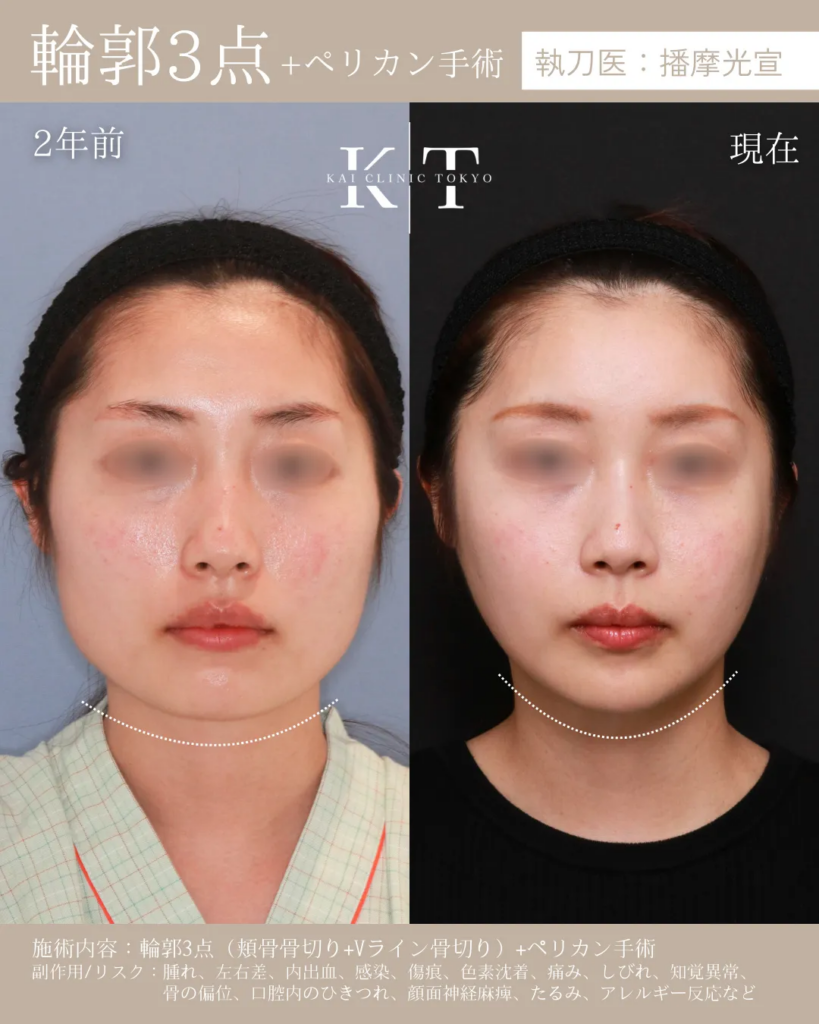
【Surgeon】
Mitsunobu Harima
【Procedure Details】
3-Point Facial Contouring (2 years ago): ¥2,530,000, Pelican Surgery (6 months ago): ¥1,100,000
【Risks and Side Effects】
Swelling, asymmetry, bruising, infection, scarring, hyperpigmentation, pain, numbness, sensory abnormalities, bone displacement, intraoral tightening, facial nerve palsy, sagging, allergic reactions, etc.
3-Point Facial Contouring
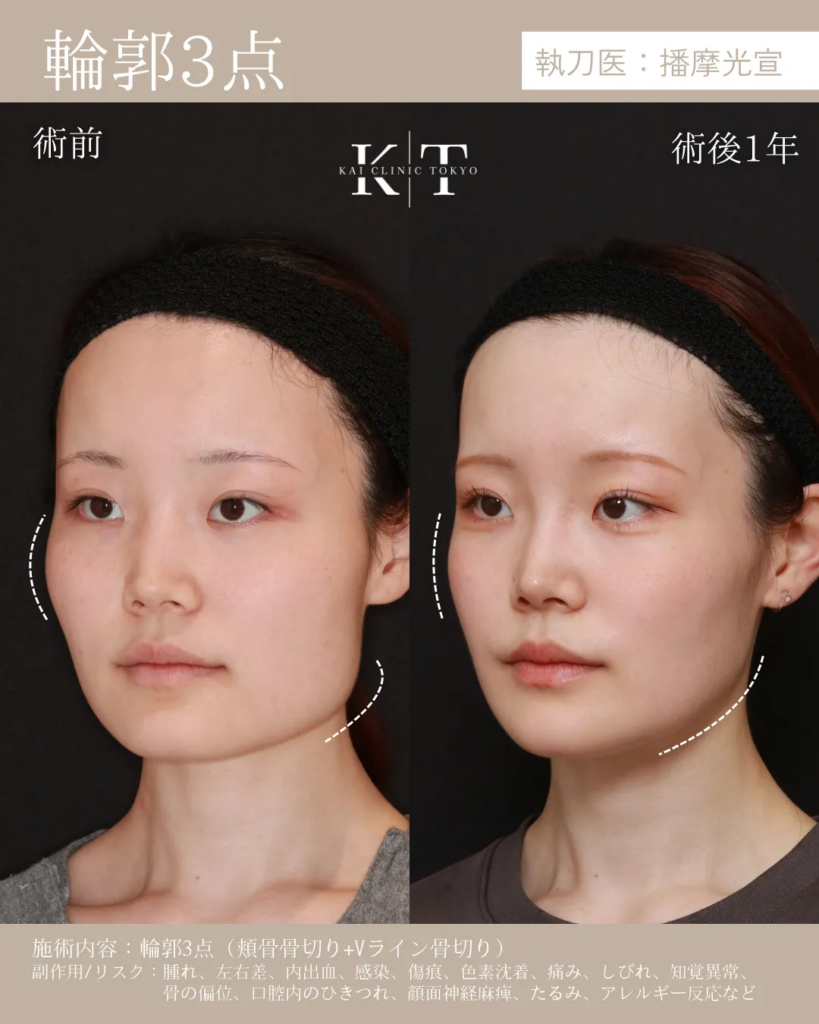
【Surgeon】
Mitsunobu Harima
【Procedure Details】
3-Point Facial Contouring (V-line bone cutting + cheekbone reduction): ¥2,530,000
*We also offer a monitor program, so please feel free to inquire.
【Risks and Side Effects】
Swelling, asymmetry, bruising, infection, scarring, hyperpigmentation, pain, numbness, sensory abnormalities, bone displacement, intraoral tightening, facial nerve palsy, sagging, allergic reactions, etc.
If You Are Considering Jaw Reduction Surgery, Please Consult KAI CLINIC TOKYO
Jaw reduction surgery requires expert judgment at every step, from identifying the cause to selecting the procedure.
If you would like to know which treatment is right for you, please feel free to consult KAI CLINIC TOKYO.
At KAI CLINIC TOKYO, we propose a treatment plan tailored to each individual's bone structure and concerns, based on consultations by certified plastic surgery specialists and 3D simulation.
We offer a wide range of options from non-surgical procedures to surgeries that address the bone structure, so please start by registering on LINE and feel free to contact us.
Summary
The causes of prominent jaws fall into three categories—muscle, bone structure, and fat—and the appropriate procedure differs for each.
However, since some procedures can significantly change the impression of the face, choosing a clinic based on surgical experience, the presence of certified plastic surgery specialists, thoroughness of risk explanation, and the quality of post-operative care is the surest way to avoid regret.
At KAI CLINIC TOKYO, experienced plastic surgery specialists propose procedures suited to the cause.
"I want to reduce my prominent jaw."
If this is a concern of yours, please feel free to consult KAI CLINIC TOKYO.
Supervisor of this article

Director Mitsunobu Harima
Academic Affiliations
Japan Society of Plastic and Reconstructive Surgery
Japan Society of Aesthetic Plastic Surgery (JSAPS)
Titles & Qualifications
Japan Society of Plastic and Reconstructive Surgery Specialist
Japan Society of Aesthetic Plastic Surgery (JSAPS) Specialist
Career
-
Graduated from the Faculty of Medicine, University of Tokyo
-
Nadogaya Hospital, Initial Resident Physician
-
University of Tokyo Hospital, Department of Plastic & Aesthetic Surgery, Special Clinical Physician
-
University of Tokyo Hospital, Department of Plastic & Aesthetic Surgery, Assistant Professor
-
Kanto Central Hospital, Department of Plastic Surgery
-
Tokyo Metropolitan Police Hospital, Department of Plastic & Aesthetic Surgery
-
Appointed Director of Kato Clinic ANNEX
-
KAI CLINIC TOKYO Appointed Director