


Causes of a Square Jaw | A Complete Guide to Improvement Methods by Type and Cosmetic Surgery
Many people notice the squareness of their jaw or face line every time they look in the mirror.
The square appearance of the jaw involves multiple factors, including muscle, bone structure, fat, and lifestyle habits.
Effective approaches differ depending on the cause, and correctly identifying your type is the first step toward improvement.
In this article, we organize the causes of a square jaw by type and explain improvement methods as well as points to consider when choosing a clinic.
4 Causes of a Square Jaw
The factors that make the jaw appear square are not just one; they differ from person to person.
Here we explain four representative causes.
Flared Jaw Due to Developed Masseter Muscles
A flared jaw, where the sides of the jaw protrude outward, is often caused by developed masseter muscles.
The masseter muscle is located on the side of the cheek and is used when chewing. When it becomes overly developed, the side of the jaw protrudes outward and the face contour appears square.
The main causes of masseter muscle development are as follows.
- Habits of clenching or grinding teeth
- Frequently chewing hard foods
- Unconscious clenching due to stress
- Habit of chewing gum for long periods
When these habits continue, the masseter muscles are strengthened and the jaw flare becomes more pronounced.
Squareness Due to Bone Structure
There are also cases where the bone structure itself creates a square contour. The closer the angle of the jaw (mandibular angle) is to 90 degrees, or the wider the chin (mentum) width, the more square the contour appears.
The main cause is genetics, and cases where family members have the same contour are common.
Ways to identify the bone structure type are as follows.
- You feel hardness in the jaw or chin area even when relaxed
- You can feel the angular bones when touching the jaw or chin
- No change even after trying massage or masseter care
- No change even after Botox injections
- The contour and jaw have been square since childhood
If these apply to you, the cause is likely bone structure rather than muscle or fat.
Squaring of the Contour Due to Fat and Sagging
The descent of fat due to aging is also a factor that makes the contour appear square. When facial fat droops and accumulates around the cheeks and under the chin, the face line becomes puffy, leading to a square impression.
The main causes of this type are as follows.
- Sagging of skin and fat due to aging
- Sagging of fat called "jowl fat" below the corners of the mouth
- Double chin due to fat accumulation under the chin
- Rapid weight gain
Even if the bone structure has not changed, the impression of the contour can change significantly due to fat distribution and sagging.
Contour Deterioration Due to Posture and Lifestyle Habits
Daily posture and lifestyle habits also affect the face line. When a downward-looking posture from prolonged smartphone use continues, downward stress is placed on the skin and fat, causing the contour to deteriorate.
The main lifestyle habits that affect the contour are as follows.
- Downward-looking posture from continued use of smartphones or PCs
- Time spent expressionless without using facial muscles
- Habit of resting one's chin on one's hand
- Habit of chewing only on one side
- Sleeping on one's side or face down
The accumulation of such habits gradually causes the contour to become puffy.
【By Cause Type】How to Improve a Square Jaw
Different causes call for different solutions. Here we explain the treatment approaches for each type and their limitations.
When the Cause Is Masseter Muscle or Fat
When muscle (masseter) or fat is the cause, the following treatment options and their limitations apply.
- Muscle (masseter):
Botox injections or a mouthguard. Easy to undergo, but effects last only 4–6 months, requiring regular repeat treatments (ongoing cost). - Fat and sagging:
Liposuction or thread lift. Effective for fat and skin laxity, but has no effect on actual bone protrusion (squareness).
Reviewing lifestyle habits such as posture and chewing habits is only a means of preventing further deterioration.
These measures cannot restore a jaw that has already become square due to bone structure. Non-bone treatments are accessible, but keep in mind that they cannot be expected to address squareness caused by skeletal structure.
For Skeletal Types: Fundamental Improvement Through Bone Surgery
When the jaw is square due to the bone itself, surface-level treatments cannot be expected to produce change, making surgical bone reduction a viable option.
The reasons bone surgery is effective for skeletal types are as follows.
- It is medically considered difficult to change bone shape through external pressure such as massage or bone manipulation (Kolggi).
- Because it directly alters the bone structure itself, more fundamental and significant small-face and contouring effects can be expected compared to other procedures.
- Since the bone itself is removed, the results are highly long-lasting, eliminating the need for repeated clinic visits as with Botox.
- A total approach encompassing not only jaw angle reduction but also the chin (mentum) allows the creation of an ideal V-line.
- Because the approach is made intraorally (through incisions inside the mouth), there is no concern about visible scarring on the surface of the face.
In the long term, it is important to choose a treatment method suited to you based on the durability of the procedure and total cost.
KAI CLINIC TOKYO's Surgical Approach to a Square Jaw
At KAI CLINIC TOKYO, we offer surgical approaches for those with a square jaw caused by skeletal structure.
Here we introduce our surgical approaches.
Mandibular Angle Reduction (Jaw Bone Shaving)
Mandibular angle reduction (jaw bone shaving) is a procedure that removes and shaves the protruding jaw angle bone to sharpen the facial contour, addressing angular facial features from both the front and side profile.
The effects that can be expected from mandibular angle reduction (jaw bone shaving) are as follows.
| Narrowing the horizontal width of the jaw (improving prominent jaw angles seen from the front) | Smoothing the angularity of the side profile (eliminating the boxy side profile) |
| Reducing the lower half of the face (small-face effect) | Correcting left-right imbalance (improving asymmetry of the jaw angles) |
- Downtime: Swelling and bruising are most noticeable for 2–3 days after surgery, gradually subsiding over about 2 weeks to a presentable state. Full recovery takes approximately 3 months.
- Risks and side effects: Swelling, bruising, pain, infection, nerve damage (numbness), asymmetry, sensory abnormalities, etc.
Genioplasty (Chin Reshaping)
Genioplasty (chin reshaping) is a procedure that moves and adjusts the chin bone to balance the overall face.
By changing the shape and position of the chin, the following improvement effects can be expected.
| Narrowing the horizontal width of the chin (sharpening a square chin) | Shortening the chin (adjusting an overly long chin) |
| Projecting the chin forward (correcting a recessed chin) | Refining the E-line of the side profile |
- Downtime: Swelling and bruising are most noticeable for 2–3 days after surgery, gradually subsiding over about 2 weeks to a presentable state. Full recovery takes approximately 3 months.
- Risks and side effects: Swelling, bruising, pain, infection, nerve damage (numbness), asymmetry, sensory abnormalities, etc.
Combining this with mandibular angle reduction (jaw bone shaving) allows for a well-defined contour from both the front and side profile.
Learn more about Genioplasty3-Point Facial Contouring (Jaw Angle, Cheekbone, and Chin Bone Surgery)
3-Point facial contouring (jaw angle, cheekbone, and chin bone surgery) is a comprehensive small-face surgery combining bone reduction at three sites—jaw angle, cheekbones, and chin—allowing multiple concerns to be addressed at once.
The expected effects are as follows.
| Dramatic small-face effect at the skeletal level | Correction of an elongated face, protruding chin, or underbite |
| Smooth, feminine oval facial contour | Intraoral approach minimizes external scarring |
- Downtime: Swelling and bruising are most noticeable for 2–3 days after surgery, gradually subsiding over about 2 weeks to a presentable state. Full recovery takes approximately 3 months.
- Risks and side effects: Swelling, bruising, pain, infection, nerve damage (numbness), asymmetry, sensory abnormalities, etc.
How to Choose a Clinic for Improving a Square Jaw
Because the skill level in bone surgery directly affects results, careful clinic selection is essential.
Here we introduce four key points to check when choosing a clinic.
Number of Bone Surgery Cases and Physician Expertise
Bone surgery requires thorough knowledge of bone structure, nerves, and blood vessel positioning, as well as precise technique. Furthermore, since bone surgery is difficult to revise, entrusting the procedure to an experienced physician is an absolute prerequisite.
When selecting a clinic, be sure to confirm the following points.
- Does the clinic have an extensive number of bone surgery cases?
- Are there physicians holding specialist qualifications in plastic surgery or cosmetic surgery?
- Is jaw and facial contouring treatment a specialty area of the clinic?
- Does the physician have a track record of academic presentations or published papers?
Thoroughness of Consultation and Risk Explanation
Trustworthy clinics honestly disclose not only the benefits but also the risks. Whether an individualized diagnosis is made based on each patient's bone structure directly affects the outcome and safety of the procedure.
During the consultation, please make sure to confirm the following points.
- Does the clinic carefully listen to your concerns and wishes?
- Does the physician accurately diagnose the cause type?
- Are the risks and disadvantages of the procedure explained, not just the benefits?
- If deemed unsuitable, will the clinic honestly communicate that?
- Does the clinic avoid high-pressure sales tactics or pushing for an immediate decision?
Publication of Case Photos and Transparency
The availability of case photos serves as a basis for evaluating a clinic's track record and transparency. The more unedited, realistic photos that are publicly available, the more concretely you can envision the results.
The following are points we recommend checking when reviewing case photos.
- Are cases from procedures performed at the clinic itself included?
- Are before-and-after results shown in a clear and easy-to-understand manner?
- Are there cases similar to your own concerns or type?
- Do the results look natural and free of any sense of unnaturalness?
- Are photos taken from multiple angles?
Aftercare and Post-Operative Follow-Up System
When choosing a clinic for jaw osteotomy, it is also important to consider the post-operative follow-up system. A reliable backup system capable of responding promptly to any unexpected changes in condition or complications is essential.
The following are points to confirm regarding aftercare.
- Is the post-operative observation schedule clearly defined?
- Is an emergency contact system in place?
- Is there a smooth response to swelling and pain?
- Is there a follow-up or revision response available in the event of a problem?
- Are aftercare costs clearly stated?
KAI CLINIC TOKYO's Approach to a Square Jaw
At KAI CLINIC TOKYO, we have provided surgical approaches to many patients troubled by a square jaw.
Here, we introduce some of our clinic's cases.
Facial Contour 3-Point + Pelican Surgery
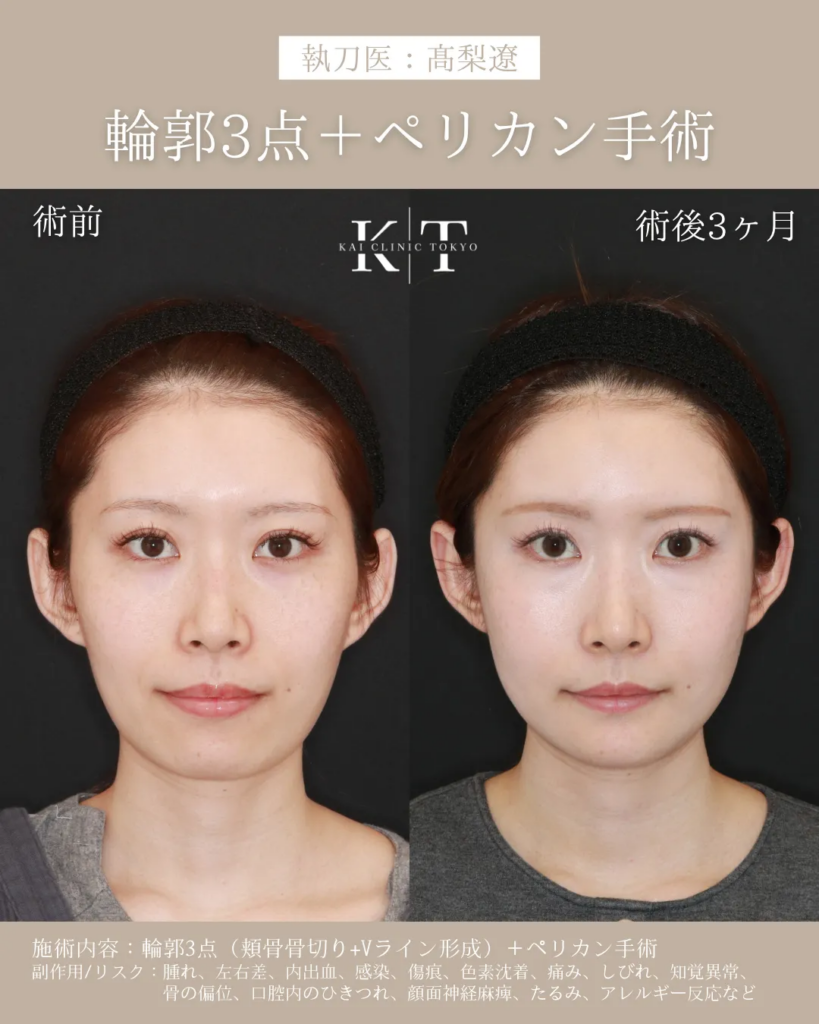
【Surgeon】
Ryo Takanashi
【Treatment Details】
Facial Contour 3-Point (Cheekbone Osteotomy + V-Line Contouring): ¥2,530,000, Submental Muscle Tightening (Pelican Surgery): ¥1,100,000
【Risks/Side Effects】
Swelling, asymmetry, bruising, infection, scarring, pigmentation, pain, numbness, sensory abnormalities, bone displacement, intraoral tightness, facial nerve palsy, sagging, allergic reactions, etc.
Facial Contour 3-Point + Under-Eye Treatment
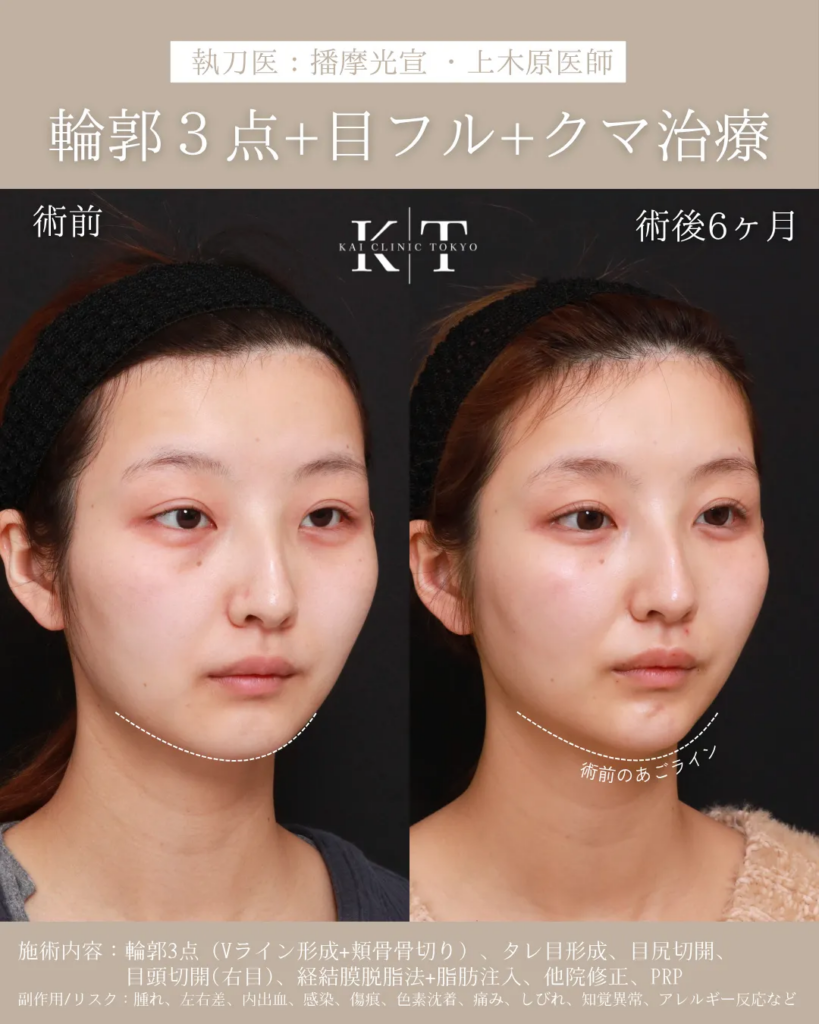
【Surgeon】
Mitsunobu Harima
Tatsuya Uekihara
【Treatment Details】
Facial Contour 3-Point (Cheekbone Osteotomy + V-Line Osteotomy): ¥2,530,000, Lateral Canthoplasty (with lower eyelid lowering): ¥132,000, Droopy Eye Correction (lower eyelid lowering skin incision): ¥506,000, Epicanthoplasty: ¥275,000, Under-Eye Treatment (transconjunctival fat removal + fat injection): ¥605,000, Under-Eye Treatment (revision from another clinic): ¥110,000, PRP Injection Wound Treatment (small): ¥88,000
【Risks/Side Effects】
Swelling, asymmetry, bruising, infection, scarring, pigmentation, pain, numbness, sensory abnormalities, bone displacement, intraoral tightness, facial nerve palsy, sagging, allergic reactions, etc.
If You Are Concerned About a Square Jaw, Please Consult KAI CLINIC TOKYO
The causes of a square jaw vary from person to person, and it is difficult to identify the appropriate improvement method through self-assessment alone.
Therefore, it is important to first consult a specialist to accurately understand your bone structure and the type of cause.
At KAI CLINIC TOKYO, drawing on our extensive track record in osteotomy, we provide diagnosis and proposals tailored to each patient's individual facial contour.
If you have any concerns about a square jaw, please feel free to consult KAI CLINIC TOKYO at any time.
Summary
The main causes of a square-looking jaw are four factors: developed masseter muscles, bone structure, fat and sagging, and lifestyle habits. When bone structure is the cause, osteotomy that directly addresses the bone is an effective option.
However, since differences in surgical skill directly affect results in osteotomy, it is important to choose a clinic by confirming the number of cases, the surgeon's specialization, the thoroughness of the consultation, the transparency of case photos, and the aftercare system.
KAI CLINIC TOKYO leverages extensive experience and knowledge in osteotomy, including the Facial Contour 3-Point procedure, to propose comprehensive small-face contouring surgery tailored to each patient's bone structure.
If you are considering addressing the root cause of your square jaw, please feel free to consult our clinic at any time.
Supervisor of this article

Director Mitsunobu Harima
Academic Societies
Japan Society of Plastic and Reconstructive Surgery
Japan Society of Aesthetic Plastic Surgery (JSAPS)
Titles & Qualifications
Japan Society of Plastic and Reconstructive Surgery Specialist
Japan Society of Aesthetic Plastic Surgery (JSAPS) Specialist
Career
-
Graduated from the Faculty of Medicine, University of Tokyo
-
Nadogaya Hospital, Initial Resident Physician
-
University of Tokyo Hospital, Department of Plastic & Aesthetic Surgery, Special Clinical Physician
-
University of Tokyo Hospital, Department of Plastic & Aesthetic Surgery, Assistant Professor
-
Kanto Central Hospital, Department of Plastic Surgery
-
Tokyo Metropolitan Police Hospital, Department of Plastic & Aesthetic Surgery
-
Appointed as Director of Kato Clinic ANNEX
-
KAI CLINIC TOKYO Appointed as Director