



What Sets a Top Osteotomy Surgeon Apart from an Average Doctor? Key Criteria You Should Know

Bone contouring surgery is a procedure that shaves or cuts the bones of the jaw, mouth area, cheeks, and angles to achieve the ideal facial contour.
While it can be highly effective for concerns stemming from bone structure, it is also a "major surgery" that places a significant burden on the body.
It carries serious risks including postoperative swelling, bruising, pain, and nerve damage. Furthermore, since it is extremely difficult to restore a bone once it has been shaved, choosing the right surgeon is crucial when aiming for the ideal contour.
This article explains the differences between a top surgeon and an average physician for bone contouring surgery, and the criteria for making an informed decision.
What is the difference between a top surgeon and an average physician for bone contouring?
The decisive difference between a top surgeon and an average physician in bone contouring lies in whether they can operate not merely by "shaving bone," but by calculating the postoperative changes as well.
In the case of an average physician, prioritizing the patient's wish to "make the face smaller" may lead to shaving too much bone.
A top surgeon, on the other hand, meticulously calculates future changes while fulfilling the patient's ideal. Because the procedure is performed with consideration for long-term risks as well as aesthetic appearance, it tends to lead to stable, lasting results.
While keeping the patient's ideal as the top priority, top surgeons also provide thorough explanations of risks and precautions based on medical evidence, creating an environment where patients can proceed with treatment fully informed and reassured.
Benefits of consulting a top surgeon
Here are three representative benefits that arise from entrusting your surgery to a top surgeon.
Safety considerations based on anatomical knowledge
In bone contouring surgery, ensuring safety is the top priority.
A top surgeon has an accurate understanding of the facial nerve and blood vessel pathways, enabling precise judgment of safe lines to shave while avoiding risks.
Based on this anatomical knowledge, they can pursue the ideal contour suited to each patient's bone structure while ensuring safety.
Advanced design reproduction at the millimeter level
A top surgeon utilizes 3D simulation and other tools to plan the patient's desired result with millimeter-level precision.
The ability to reproduce with extremely high accuracy during actual surgery the plan for where and how much bone to shave is the hallmark of a top surgeon's skill.
Because the shape can be refined to the millimeter as planned in the simulation, discrepancies from the expected result are less likely, and the desired contour can be achieved to the patient's satisfaction.
Treatment that accounts for excess skin and sagging
Bone contouring is not simply about reducing bone; it must be performed with the postoperative condition of the skin in mind.
Shaving too much of the underlying bone can risk causing skin sagging, sunken cheeks, or a distorted-looking contour.
A top surgeon anticipates how the skin will change after bone reduction and performs the appropriate treatment accordingly.
Key points for choosing a top surgeon for bone contouring
To achieve satisfying results, it is essential to identify a surgeon with superior skills and reliability.
Here are five key points to prioritize when choosing a top surgeon.
Whether the surgeon holds specialist qualifications
One objective criterion for assessing a surgeon's skill is specialist qualifications from organizations such as the Japanese Society of Plastic and Reconstructive Surgery or the Japan Society of Aesthetic Plastic Surgery (JSAPS).
These qualifications are awarded only to physicians who have completed a set period of training, accumulated extensive surgical experience, and passed rigorous examinations.
For a highly demanding procedure like bone contouring, whether the surgeon possesses a solid foundation in plastic surgery knowledge and high-level expertise is an essential item to verify.
Extensive case experience
A large number of cases is proof of experience handling a wide variety of bone structures.
Because bone contouring involves individual differences in bone thickness, hardness, and nerve pathways, it cannot be managed with standardized techniques alone.
A surgeon with extensive case experience is capable of flexible adjustments tailored to each individual's bone structure, which translates into greater surgical stability and precision.
Thorough Counseling
Regarding the patient's wishes of "how they want to look," check whether the doctor clearly communicates what is and is not medically possible, and whether they are willing to engage until you are fully satisfied.
A doctor who uses simulations and other tools to share a clear image of the expected results and works to ensure there are no discrepancies is one you can trust to perform your surgery with confidence.
Comprehensive After-Care System
Osteotomy surgery involves a long post-operative downtime and requires ongoing monitoring. Whether there is a guarantee system in place in case of complications, and whether the clinic is equipped to respond quickly to any post-operative concerns, are important criteria when choosing a doctor or clinic.
It is essential to determine whether there is a system in place to provide responsible support through to the final result, rather than simply performing the surgery and considering the job done.
Collaboration with Other Departments
Osteotomy surgery is performed under general anesthesia, making collaboration with an anesthesiologist essential.
In addition, for surgeries involving the bite (occlusion), whether there is a cooperative system in place with dentistry and oral surgery is also a major consideration.
A clinic with a system that can provide support drawing on the expertise of multiple specialists can be considered highly reliable in terms of both safety and the quality of results.
If You Are Considering Osteotomy Surgery, Please Consult KAI CLINIC TOKYO
KAI CLINIC TOKYO has doctors with extensive surgical experience and knowledge in osteotomy surgery, and performs precise procedures tailored to each patient's individual bone structure.
Through thorough counseling, we share the ideal outcome with each patient, and strive to provide high-precision osteotomy surgery by leveraging our continuously refined skills and knowledge.
Furthermore, we do not simply perform surgery and stop there — we are committed to thorough post-operative after-care. We have a system in place to respond promptly to any concerns or questions during the downtime period, supporting patients so they can focus on recovery with peace of mind.
If you are looking for osteotomy surgery performed by a doctor with proven skills, please feel free to book a counseling session via our clinic's official LINE account.
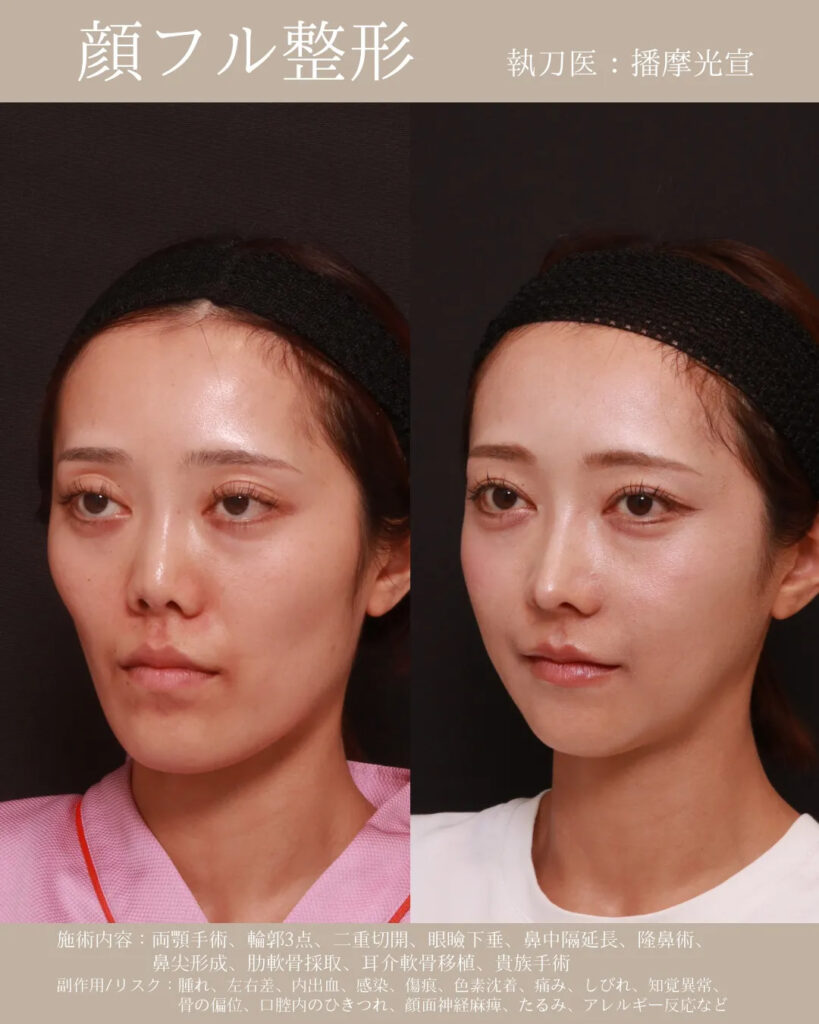
【Surgeon】
Mitsunobu Harima
【Treatment Details & Fees】
Bimaxillary surgery: ¥2,970,000 / Facial contouring 3-point: ¥2,530,000 / Ptosis repair + double eyelid surgery: ¥770,000 / Septal extension: ¥495,000 / Rhinoplasty (augmentation): ¥330,000 / Nasal tip plasty: ¥330,000 / Costal cartilage harvesting: ¥660,000 / Auricular cartilage graft: ¥165,000 / Alarplasty (noble surgery): ¥275,000
【Risks & Side Effects】
Swelling, asymmetry, bruising, infection, scarring, hyperpigmentation, pain, numbness, sensory abnormalities, bone displacement, intraoral contracture, facial nerve palsy, sagging, allergic reactions, etc.
Summary
Osteotomy surgery can help you achieve your ideal facial contour, but it is not simply a matter of shaving bone.
Rather than judging by surface-level information alone, what matters is how much the surgeon has honed their skills and how sincerely they engage with each patient's individual bone structure.
Taking the time to consult until you are fully satisfied and choosing a doctor you can trust are the key factors in getting closer to your ideal appearance.
At KAI CLINIC TOKYO, we leverage our continuously refined skills and knowledge to provide treatment tailored to each individual patient.
We offer a system designed to help you achieve your ideal results, from pre-operative advice through to post-operative follow-up, so if you are considering osteotomy surgery, please feel free to contact us for a consultation.
Supervisor of This Article

Director Mitsunobu Harima
Academic Societies
Japan Society of Plastic and Reconstructive Surgery
Japan Society of Aesthetic Plastic Surgery (JSAPS)
Titles & Qualifications
Board-Certified Specialist, Japan Society of Plastic and Reconstructive Surgery
Board-Certified Specialist, Japan Society of Aesthetic Plastic Surgery (JSAPS)
Career
-
Graduated from the Faculty of Medicine, University of Tokyo
-
Nadogaya Hospital, Initial Residency
-
University of Tokyo Hospital, Department of Plastic & Aesthetic Surgery, Special Clinical Physician
-
University of Tokyo Hospital, Department of Plastic & Aesthetic Surgery, Assistant Professor
-
Kanto Central Hospital, Department of Plastic Surgery
-
Tokyo Metropolitan Police Hospital, Department of Plastic & Aesthetic Surgery
-
Kato Clinic ANNEX, Appointed Director
-
KAI CLINIC TOKYO, Appointed Director