



【Supervised by a Doctor】How to Get a Smaller Face | The Limits of Self-Care and Recommended Cosmetic Treatments

Many people search the internet hoping to achieve a smaller face, come across various self-care methods, and actually put them into practice.
However, did you know that self-care methods for achieving a smaller face not only have their limits, but also carry the risk of causing damage?
In this article, we explain why self-care has its limits and introduce cosmetic medical treatments that can address the root causes of a larger-looking face.
Main Causes of a Large-Looking Face
Bone Structure
When bone structure is the cause of a large-looking face, genetic factors are often involved. The size of the skull—including downward development or forward protrusion of the lower jaw—plays a role as described below.
- Cases where the jaw angle (mandibular angle) protrudes outward, or the cheekbones project laterally or forward
- Midface depression due to underdevelopment of the upper jaw, or an elongated facial impression caused by upper jaw protrusion
Proportion and Placement Balance of Facial Features
In some cases, the face appears large not because of its actual size, but due to the placement of facial features and the balance with the body.
Specifically, the following causes may be involved.
- Large amount of "negative space" relative to the face area:
When the distance from the eyes to the temples or from the mouth to the chin is long, features appear clustered toward the center, emphasizing the surrounding negative space. - Midface length and philtrum length:
A long philtrum (area below the nose) or a low alar base (base of the nose) can give the impression that the face is vertically stretched, creating a drawn-out look. - Changes in the hairline:
When fine hairs and hair volume decrease and the hairline recedes, the forehead area expands, increasing facial exposure and making the face appear relatively larger. - Balance with the body:
Narrow shoulder width or a proportionally large head relative to overall body height can visually emphasize the size of the face.
Lifestyle and Constitution
Daily habits and constitution can increase facial volume, making the face appear larger.
- Muscle development (jaw flaring):
Habitual clenching or grinding of teeth causes the masseter muscle to overdevelop and protrude outward. - Fat accumulation and distribution:
In addition to subcutaneous fat in the cheeks and under the chin, the buccal fat located in the deeper layers of the cheeks can descend, adding volume to the lower half of the face. - Facial "puffiness":
A state in which excess fluid accumulates due to excessive salt intake, alcohol consumption, or poor circulation. - "Sagging" of skin and tissue:
With age, the skin loses elasticity, and the retaining ligaments that support the skin loosen, causing fat and skin to droop downward under gravity.
Limits and Risks of Self-Care Such as Face-Slimming Massage
As mentioned at the beginning, information about various self-care methods such as face-slimming massage has spread widely, but the effort to "fix it on your own" may negatively impact your facial appearance in the future.
Here we explain why self-care has limits and risks.
"Serious Sagging" Caused by Ligament Laxity
Massaging with strong force stretches the ligaments that support the skin, causing "sagging" that cannot be reversed on its own.
In addition, it can also cause damage to the soft tissue surrounding the ligaments, so caution is necessary.
Skin Damage from Friction
Strong stimulation to the delicate skin of the face can actually increase pigmentation and fine wrinkles.
Self-care such as massage cannot move bones
Methods found online, such as face-slimming massage and face-slimming exercises, have no medical evidence.
Since it is impossible to change bone structure with hand pressure, if you want to change the bone structure itself, a surgical approach based on anatomy is necessary.
How to achieve a smaller face with "bone-cutting surgery"
When a large-looking face is caused by bone structure, a surgical approach using bone-cutting surgery is effective.
Small face & facial contouring by bone-cutting of the jaw, cheeks, and chin (3-point contouring)
Bone-cutting surgery of the jaw, cheeks, and chin (3-point contouring) is a procedure that reshapes the protruding bone structure (jaw angle, cheekbones, and chin tip) to improve facial line balance and create a clean, well-defined contour.
The goal is not simply to create a smaller face, but to harmonize the overall balance of the face.
- Downtime:
Swelling and bruising are most noticeable for 2–3 days after surgery, but gradually subside within about 2 weeks, at which point you can appear in public. It takes about 3 months to fully settle. - Risks & side effects:
Possible complications include swelling, asymmetry, bruising, infection, scarring, pigmentation, foreign body reaction, pain, numbness, sensory abnormalities, hair loss, tissue necrosis, vision impairment, facial nerve damage, allergic reactions, and shock reactions.
Cheekbone Setback
Cheekbone setback is a procedure that moves the entire protruding cheekbone inward and backward to reduce cheek prominence and facial width, creating a smoother facial line.
- Downtime:
Swelling and bruising are most noticeable for 2–3 days after surgery, but gradually subside within about 2 weeks, at which point you can appear in public. It takes about 3 months to fully settle. - Risks & side effects:
Possible complications include swelling, asymmetry, bruising, infection, scarring, pigmentation, foreign body reaction, pain, numbness, sensory abnormalities, hair loss, tissue necrosis, vision impairment, facial nerve damage, allergic reactions, and shock reactions.
Le Fort I Osteotomy + Sagittal Split Ramus Osteotomy (SSRO) Treatment
The "double jaw surgery" combining the "Le Fort I osteotomy," which addresses the upper jaw, and the "sagittal split ramus osteotomy (SSRO)," which addresses the lower jaw, can dramatically change facial proportions.
- Downtime:
Swelling and bruising are most noticeable for 2–3 days after surgery, but gradually subside within about 1 month, at which point you can appear in public. It takes about 6 months to fully settle. - Risks & side effects:
Possible complications include swelling, asymmetry, bruising, infection, scarring, pigmentation, foreign body reaction, pain, numbness, sensory abnormalities, hair loss, tissue necrosis, vision impairment, facial nerve damage, allergic reactions, and shock reactions.
How to achieve a smaller face by adjusting the proportion and placement of facial features
When the face appears large due to the balance of facial features, adjusting the proportions and placement of those features can be expected to create a face-slimming effect.
Lip Lift (Philtrum Shortening)
A lip lift (philtrum shortening) is a surgery that removes a few millimeters of skin from under the nose to shorten the distance between the nose and lips, improving the overall balance of the face.
- Downtime:
Swelling and bruising are most noticeable for 2–3 days after surgery. They gradually subside within 1–2 weeks and fully settle within about 3 months. - Risks & side effects:
Possible complications include swelling, scarring, redness, pain, bruising, edema, numbness, deformity, and allergic reactions.
Nasal Tip Plasty
Nasal tip plasty is a surgery to eliminate roundness at the tip of the nose and create a clean, sharp impression.
By refining the tip of the nose, the gaze naturally gathers toward the center of the face, and even though the overall facial area does not change, a face-slimming effect can be expected, making the face look tighter and more compact.
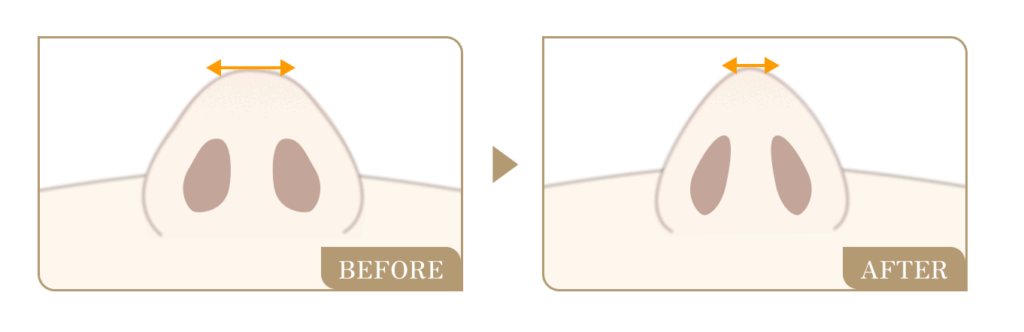
- Progress & downtime:
The downtime is approximately 3 months, with swelling and bruising most noticeable in the 1–2 weeks following surgery. - Risks & side effects:
Possible complications include swelling, bruising, pain, edema, redness, infection, scarring, and asymmetry.
Noble Surgery (Alar Base Augmentation)
Noble surgery (alar base augmentation) is a procedure that projects the base of the nose forward to eliminate a sunken appearance.
By inserting a prosthesis or cartilage at the base of the nostrils to physically lift the foundation, three-dimensionality is created across the entire face, filling in the visual negative space, and a tighter, smaller-looking face impression can be expected.
- Downtime: Swelling and bruising may occur after surgery.
- Side effects & risks: Possible complications include swelling, redness, bruising, pain, tightness, and unevenness (which improve over time).
Other Methods for Achieving a Smaller Face
KAI CLINIC TOKYO offers additional menu options expected to provide a small-face effect beyond the treatments already introduced.
However, the options introduced here provide only temporary effects, so continued treatments are necessary if you wish to maintain the results.
- Liposuction:
A surgical slimming procedure in which the skin is made a small incision, a thin tube (cannula) a few millimeters in diameter is inserted subcutaneously, and fat is suctioned out. - Buccal Fat Removal:
By removing the buccal fat (fatty tissue located deep in the cheeks), a sharp and contoured face line can be achieved. - Thread Lift:
A procedure in which special absorbable barbed threads are inserted subcutaneously to physically lift sagging skin. - Botox Injection:
A treatment that softens muscle movement to improve wrinkles, tighten contours, and achieve a smaller-face effect. - Hyaluronic Acid Injection:
A procedure in which hyaluronic acid filler is injected directly into areas of concern to reshape the contours. - Ultrasound/High-Frequency Device Treatment (InMode Lift, HIFU, Volnewma, Morpheus, etc.):
A minimally invasive treatment that uses ultrasound or high-frequency energy to tighten the skin and fascia and target fat. Downtime is relatively short, but individual results in longevity of effect may vary.
Case Studies of Small-Face Surgery at KAI CLINIC TOKYO
KAI CLINIC TOKYO has provided treatments for a small-face effect to a great number of patients.
Here we introduce actual case studies of patients who received small-face surgery at our clinic.
Full Face
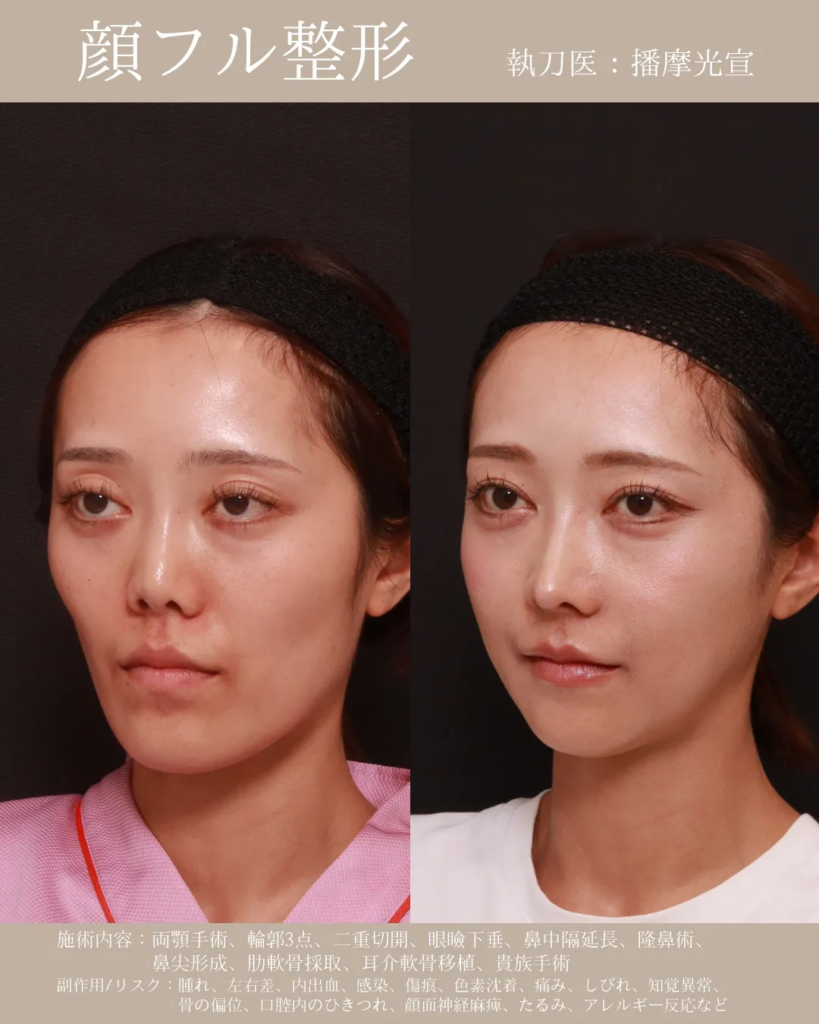
【Surgeon】
Mitsunobu Harima
【Treatment Details】
Double jaw surgery: ¥2,970,000 / Facial contour 3-point: ¥2,530,000 / Ptosis correction + double eyelid surgery: ¥770,000 / Columellar strut graft: ¥495,000 / Rhinoplasty (augmentation): ¥330,000 / Nasal tip plasty: ¥330,000 / Costal cartilage harvest: ¥660,000 / Auricular cartilage graft: ¥165,000 / Alar base reduction: ¥275,000
【Risks & Side Effects】
Swelling, asymmetry, bruising, infection, scarring, hyperpigmentation, pain, numbness, sensory abnormalities, bone displacement, intraoral tightness, facial nerve palsy, sagging, allergic reactions, etc.
Facial Contour × Sagging Treatment
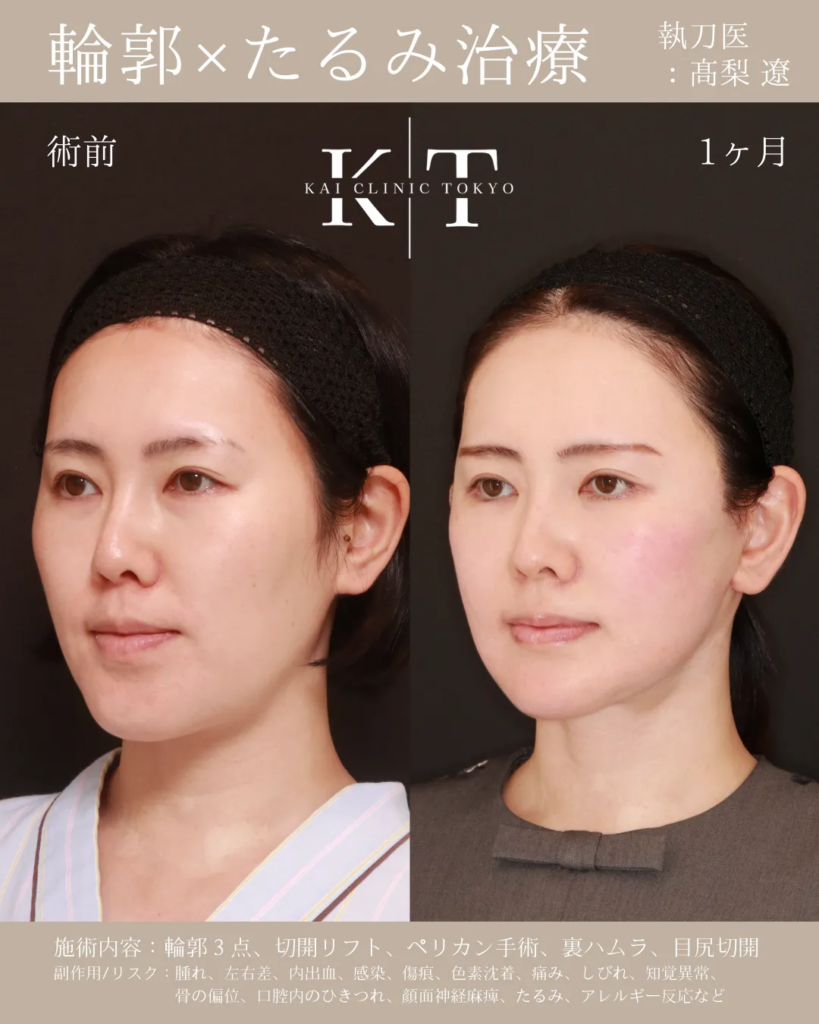
【Surgeon】
Ryo Takanashi
【Treatment Details & Fees】
Facial contour 3-point (1 year prior): ¥2,530,000 / Incisional lift: ¥2,200,000 / Pelican surgery: ¥1,100,000 / Transconjunctival Hamra: ¥495,000 / Lateral canthoplasty: ¥264,000
【Risks & Side Effects】
Swelling, asymmetry, bruising, infection, scarring, hyperpigmentation, pain, numbness, sensory abnormalities, bone displacement, intraoral tightness, facial nerve palsy, sagging, allergic reactions, etc.
How to Choose a Clinic You Won't Regret for Achieving a Smaller Face
Cosmetic treatments for a smaller face are not without risks—for example, some procedures such as bone contouring cannot be reversed once performed, and results may differ from what was imagined.
Therefore, to avoid regret, it is extremely important to keep the following points in mind and choose a clinic you can trust.
- Does the clinic offer proposals tailored to your specific cause?:
Choose a doctor who can give you convincing reasons for why a particular approach is best suited to your facial type. - Do the before-and-after photos look natural?:
Clinics that show cases from multiple angles and demonstrate natural appearance during movement tend to have higher credibility. - Does the clinic honestly disclose the disadvantages?:
You can feel at ease with a doctor who thoroughly explains risks and negative aspects and works with you to consider countermeasures.
If You're Aiming for a Smaller Face, Consult KAI CLINIC TOKYO
There are many types of cosmetic treatments for achieving a smaller face, and the most suitable procedure differs depending on each patient's ideal outcome and facial condition.
At KAI CLINIC TOKYO, we leverage our extensive track record of experience and knowledge to the fullest to propose treatments that help each patient achieve their ideal smaller face.
"I've tried hard with self-care, but there's no sign of my face getting smaller."
"I'd like to try cosmetic treatment, but I don't know which procedure is right for me."
If you have such concerns, please feel free to consult KAI CLINIC TOKYO.
Summary
Although a wide variety of information about self-care for achieving a smaller face circulates on the internet, it is simply not possible to move bones or facial features on your own.
Moreover, caution is required as there is a risk of worsening wrinkles and sagging.
At KAI CLINIC TOKYO, we first carefully assess your facial condition during a consultation, and then propose the best approach from among our many available treatments to help you achieve your ideal.
If you are looking to resolve your concerns about facial size and attain "beauty that is uniquely you," please feel free to take advantage of our clinic's consultation service.
Supervisor of this article

Director Mitsunobu Harima
Academic Societies
Japan Society of Plastic and Reconstructive Surgery
Japan Society of Aesthetic Plastic Surgery (JSAPS)
Titles & Qualifications
Specialist, Japan Society of Plastic and Reconstructive Surgery
Specialist, Japan Society of Aesthetic Plastic Surgery (JSAPS)
Career
-
Graduated from the Faculty of Medicine, The University of Tokyo
-
Nadogaya Hospital – Resident Physician
-
The University of Tokyo Hospital – Department of Plastic & Aesthetic Surgery, Specially Appointed Clinical Physician
-
The University of Tokyo Hospital – Department of Plastic & Aesthetic Surgery, Assistant Professor
-
Kanto Central Hospital – Department of Plastic Surgery
-
Tokyo Metropolitan Police Hospital – Department of Plastic & Aesthetic Surgery
-
Kato Clinic ANNEX – Appointed as Director
-
KAI CLINIC TOKYO Appointed as Director