


Causes of a Long Mid-Face | Cosmetic Treatments to Shorten It
"Every time I look in the mirror, I notice the excess space on my face"
"My long face makes me look older than I am"
Do any of these concerns sound familiar?
The length of the mid-face greatly affects your overall impression, yet the causes and remedies are not widely known.
In this article, we will explain in detail the reasons why the mid-face can appear long, the limitations of self-care, and the cosmetic medicine approaches proposed by KAI CLINIC TOKYO.
What is the Mid-Face? Basics and Ideal Length
The mid-face is an important feature that determines the overall impression of your face.
First, let us introduce the area the mid-face covers, its average length, and the balance considered ideal.
The Area the Mid-Face Covers and Its Average Length
The mid-face refers to the central section when the face is divided vertically into three equal parts.
In the field of cosmetic medicine, the area "from below the eyebrows to the edge of the upper lip" is commonly referred to as the mid-face, and the average length for Japanese women is approximately 6.5 cm.
However, this is merely one guideline, so it is important not to focus solely on the number but to consider the overall balance of the face.
Ideal Balance Based on the Golden Ratio of the Face
The face is divided into three parts: the "upper face (hairline to eyebrows)," "mid-face (eyebrows to below the nose)," and "lower face (below the nose to the chin tip)." The closer these three sections are to equal proportions, the more balanced the face is considered to appear.
When the mid-face is shorter, the distance between the eyes and mouth appears closer, tending to create a more defined impression.
However, shorter is not always better. What matters is harmony with the overall placement of facial features and bone structure, and finding the balance that suits your own facial appearance.
The Impression a Long Mid-Face Creates
The following impressions can result from having a long mid-face.
- Looking older or tired:
The increased space on the face creates a stretched-out impression, which can make you appear older than your actual age. Shadows are also more likely to form under the eyes, which may give a tired appearance. - The face appears larger:
The vertically elongated silhouette creates a visual effect that makes the entire face look larger. The so-called "long face" impression is intensified, and it also affects the balance of the profile.
Causes of a Long-Looking Mid-Face
There are several factors behind a mid-face that appears long.
Here we explain the causes from three perspectives: bone structure, aging, and lifestyle habits.
Causes Due to Congenital Bone Structure
If you have been conscious of having a long face since childhood, it is highly likely that your innate bone structure is the cause.
The length of the mid-face due to skeletal structure mainly has the following characteristic types.
- Type where the maxilla itself is vertically long:
Because the bone that forms the foundation of the face is long, the mid-face inevitably becomes longer as well. Some cases are accompanied by a "gummy smile," where the gums appear prominently when smiling. - Type where the cheekbones are positioned low or have weak forward projection:
When the cheeks lack three-dimensionality, the gaze tends to be drawn downward to the center, giving a flat and elongated impression.
Sagging and Tissue Ptosis Due to Aging
Those who feel that "my face looks longer lately, even though it didn't bother me when I was younger" may be experiencing changes caused by aging.
Aging of the mid-face is thought to be caused not so much by changes in the skeleton itself, but by changes in soft tissues such as skin and fat.
The main factors that make the mid-face appear longer with age are as follows.
- Decrease in collagen and elastin:
The components that maintain skin firmness and elasticity gradually decrease after peaking in one's 30s, making skin sagging more noticeable. - Descent of cheek fat:
As the fatty tissue located high on the cheeks descends under the force of gravity, the position of the cheeks drops, making the center of gravity of the face appear to elongate vertically. - Loosening of ligaments and facial muscles:
The ligaments and facial muscles that support the skin and fat loosen with age, causing the overall firmness of the face to be lost.
Effects of Lifestyle Habits and Posture
Everyday habits can also contribute to the mid-face appearing longer. The following habits are among the main causes.
- Posture of looking down while using a smartphone for long periods:
Spending a long time looking downward makes it harder to use the muscles of the cheeks and mouth, making sagging more likely to progress. - Sagging of muscles around the mouth due to mouth breathing:
Mouth breathing weakens the orbicularis oris muscle and causes the area around the mouth to lose its firmness. - Spending long periods with a blank expression without using facial muscles:
The overall firmness of the face is lost, and the vertical length of the mid-face tends to be relatively more emphasized. - Accumulation of skin damage from neglecting UV protection:
UV rays promote the breakdown of collagen and accelerate sagging.
Reviewing these habits can be expected to suppress progression to a certain degree, but the reality is that fundamental improvement such as shortening the mid-face is difficult.
Limitations and Risks of Self-Care for a Long Mid-Face
Many people want to shorten their mid-face through self-care.
However, fundamental improvement on one's own is difficult, and depending on the approach, it can also carry risks.
Facial Slimming Massage Cannot Change Bone Structure
The length of the mid-face is determined by anatomical structures such as the skeleton, subcutaneous tissue, and ligaments.
Therefore, it is difficult to change the length itself through self-care approaches that work on the surface, such as massage.
In addition, in adults the cranial bones have fused and are immobile, so it is not possible to improve length originating from the skeleton through self-care.
Risks of Overdoing Facial Slimming Massage
Massage that is continued with good intentions can sometimes backfire. Overdoing it may cause the following risks.
- Damage to supporting ligaments (retaining ligaments)
- Progression of sagging throughout the face
- Worsening of melasma and dark spots due to friction
Since fundamental improvement through self-care is difficult, aesthetic medicine is one option for those concerned about mid-face length.
【Non-Surgical Treatments】Aesthetic Medicine at KAI CLINIC TOKYO to Shorten the Mid-Face
For those who want to address the mid-face without using a scalpel, KAI CLINIC TOKYO offers "non-surgical treatments."
Hyaluronic Acid Injection
Hyaluronic acid injection is a treatment that, rather than simply filling wrinkles, adds volume to a high position on the cheeks to lift the overall center of gravity of the face, with the expected effect of visually reducing the impression of a long face.
- Downtime: Swelling and redness may occur but typically settle within 2–3 days
- Risks/side effects: Swelling, bruising, rare vascular complications (intravascular injection), infection, allergic reaction
Thread Lift
Thread lift is a treatment that physically lifts descended tissue back to its original position, with the expected effect of tightening and refining the mid-face.
- Downtime: Mild swelling and a feeling of tightness for several days to about one week
- Risks/side effects: Swelling, redness, bruising, pain, pulling sensation, unevenness (improves over time)
Botox Injection
Botox injection is a treatment that relaxes the muscles of the upper lip to slightly flip it upward (lip flip), with the expected effect of making the area under the nose appear shorter.
- Downtime: Swelling and redness may occur but typically settle within 2–3 days
- Risks/side effects: Bruising, mild swelling and tenderness, antibody formation with long-term continuous administration, asymmetry or stiffness of expression (can be improved with adjustment)
【Surgical Treatments】Surgical Approaches at KAI CLINIC TOKYO to Shorten the Mid-Face
For those seeking fundamental improvement by directly addressing the skeleton and tissue, KAI CLINIC TOKYO also offers surgical treatments.
Lip Lift (Philtrum Shortening)
A lip lift is a procedure in which a few millimeters of skin beneath the nose is excised to shorten the distance between the nose and lips, balancing the overall facial proportions.
- Downtime: Swelling and bruising are most noticeable for 2–3 days after surgery, gradually settling over 1–2 weeks and fully resolving in about 3 months
- Risks/side effects: Swelling, scarring, redness, pain, bruising, edema, numbness, deformity, allergic reaction, etc.
Mid-Face Lift (Midface Lift)
The mid-face lift is a procedure that simultaneously addresses dark circles under the eyes, Golgo lines, and nasolabial folds at their root cause.
By lifting the top position of sagging cheeks, it restores a youthful, three-dimensional appearance to the entire face.
- Downtime: Swelling and bruising are most noticeable for 2–3 days after surgery. They gradually subside over 1–2 weeks and fully settle within about 3 months.
- Risks/Side effects: Swelling, redness, pain, bruising, edema, numbness, ectropion, infection, allergic reactions, etc.
Le Fort I Osteotomy + Sagittal Split Ramus Osteotomy (SSRO) Treatment
This is a "bimaxillary surgery" combining the "Le Fort I osteotomy," which approaches the upper jaw, with the "sagittal split ramus osteotomy (SSRO)," which approaches the lower jaw.
It is expected to improve the balance of a long facial contour. It also dramatically corrects an underbite or protruding mouth, achieving a beautiful side profile with a well-defined E-line.
- Downtime: Swelling and bruising are noticeable for 2–3 days after surgery. They settle within about 1 month, and full recovery takes approximately 6 months.
- Risks/Side effects: Possible complications include swelling, asymmetry, bruising, infection, scarring, pigmentation, foreign body reaction, pain, numbness, sensory abnormalities, hair loss, tissue necrosis, vision impairment, facial nerve damage, allergic reactions, and shock reactions.
Key Points for Choosing a Clinic to Improve Mid-Face Length
To shorten the mid-face, choosing the right clinic is just as important as the procedure itself.
Here are some key points to help you identify a clinic you can trust with confidence.
- Does the clinic offer proposals tailored to your individual cause?:
Choose a doctor who can explain convincingly why a particular approach is best for your facial type. - Do the before-and-after photos look natural?:
Clinics that show cases from multiple angles and demonstrate natural movement in motion tend to be more trustworthy. - Does the clinic honestly disclose the disadvantages?:
A doctor who thoroughly explains risks and negative aspects and works with you to devise countermeasures is reassuring.
Mid-Face Shortening Cases
Here are some mid-face shortening cases actually performed at KAI CLINIC TOKYO.
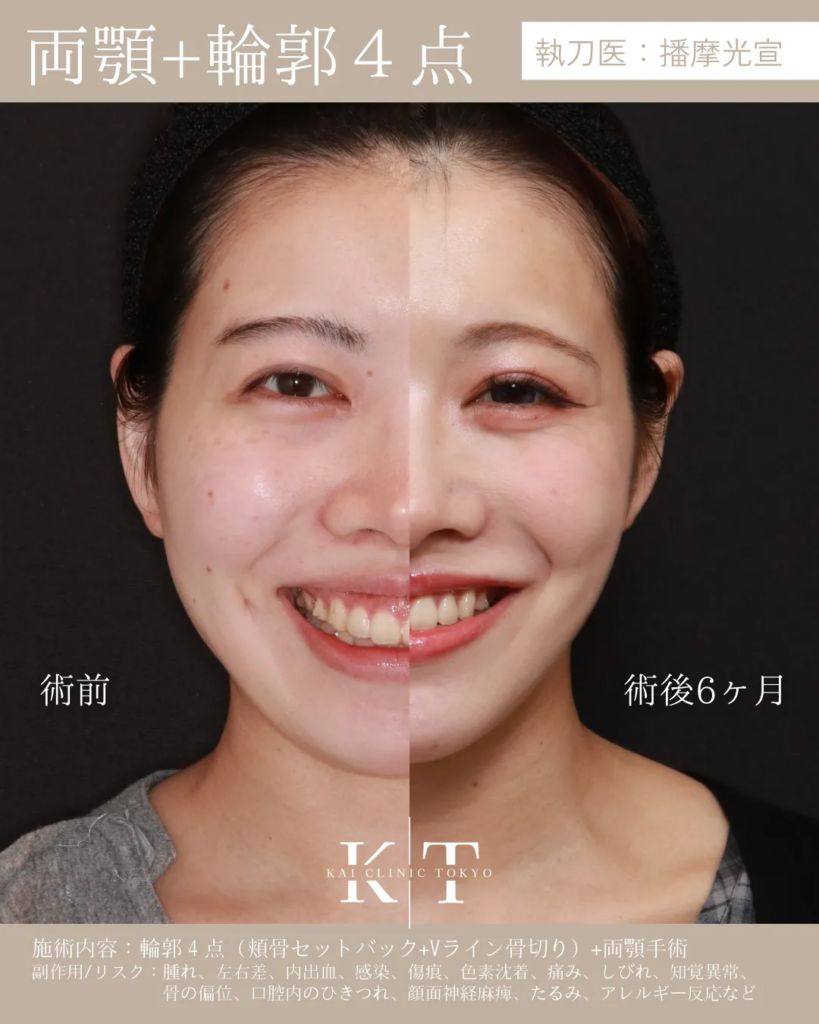
Bimaxillary + 4-Point Facial Contouring [Woman in her 20s]
[Surgeon]
Mitsunobu Harima
[Treatment Details]
Bimaxillary Surgery (Upper and Lower Jaw Osteotomy): ¥2,970,000 / 4-Point Facial Contouring (Cheekbone Setback + V-Line Osteotomy): ¥2,970,000
[Risks/Side Effects]
Swelling, asymmetry, bruising, infection, scarring, pigmentation, pain, numbness, sensory abnormalities, bone deviation, oral tightness, facial nerve palsy, sagging, allergic reactions, etc.
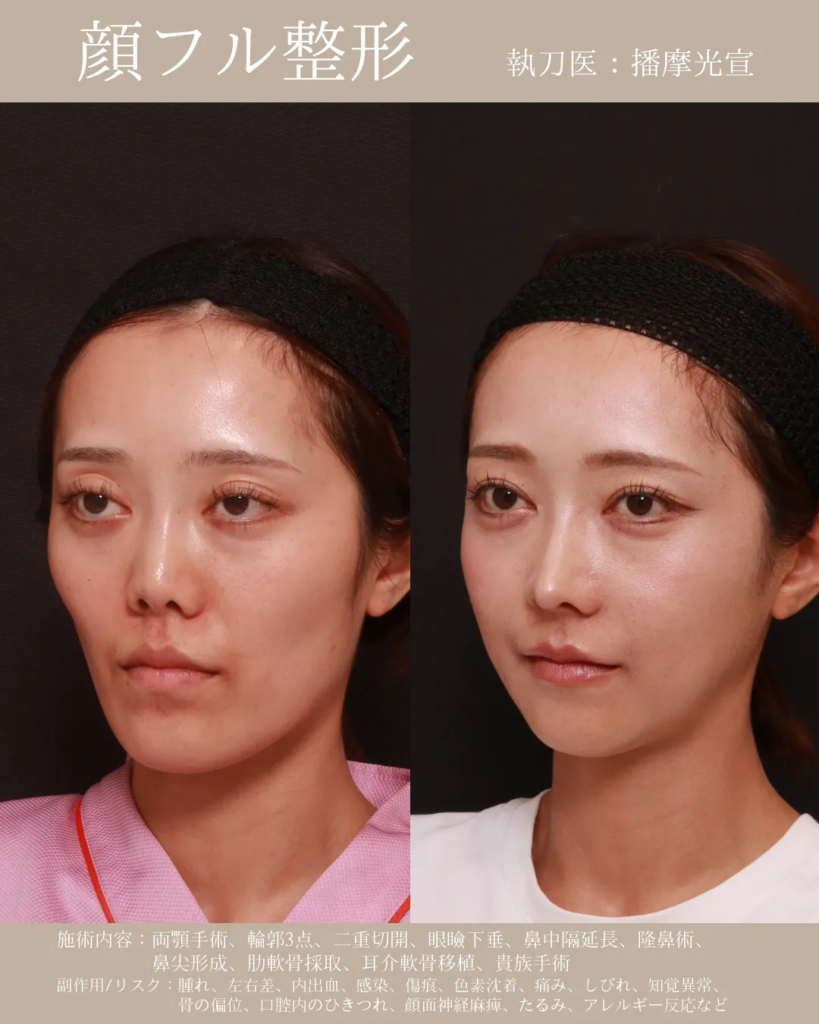
Full Face
[Surgeon]
Mitsunobu Harima
[Treatment Details]
Bimaxillary Surgery: ¥2,970,000 / 3-Point Facial Contouring: ¥2,530,000 / Ptosis Correction + Double Eyelid Surgery: ¥770,000 / Septal Extension: ¥495,000 / Rhinoplasty (Augmentation): ¥330,000 / Nasal Tip Plasty: ¥330,000 / Costal Cartilage Harvest: ¥660,000 / Auricular Cartilage Graft: ¥165,000 / Aristocrat Surgery: ¥275,000
[Risks/Side Effects]
Swelling, asymmetry, bruising, infection, scarring, pigmentation, pain, numbness, sensory abnormalities, bone deviation, oral tightness, facial nerve palsy, sagging, allergic reactions, etc.
If You Are Concerned About Your Mid-Face Appearing Long, Please Consult KAI CLINIC TOKYO
The length of the mid-face is caused by a combination of various factors, including skeletal structure, tissue descent due to aging, and lifestyle habits.
The appropriate treatment differs depending on the cause, so the first step is to correctly understand your own condition.
At KAI CLINIC TOKYO, we offer a wide range of options—from non-surgical treatments such as hyaluronic acid injections and thread lifts to surgical procedures that address bone structure—and we provide recommendations tailored to each patient's individual causes and wishes.
We will also carefully explain the risks and downtime, and work together with each patient to determine a treatment plan they are fully satisfied with.
If you are concerned about the length of your mid-face, please feel free to consult our clinic.
Our specialist physicians will carefully assess your facial balance and assist each patient in achieving the beauty they desire.
Summary
The reasons a mid-face may appear long are varied, including congenital skeletal structure, tissue descent due to aging, and lifestyle habits and posture.
However, fundamental improvement through self-care alone is difficult. If you wish to address mid-face length at its root, it is important to choose a method suited to the cause—ranging from non-surgical procedures such as hyaluronic acid injections and thread lifts to surgical approaches such as osteotomy.
At KAI CLINIC TOKYO, we propose treatments tailored to each individual's skeletal structure and concerns, and carefully explain risks and downtime.
If you are concerned about the length of your mid-face, please feel free to consult our clinic.
Supervisor of this article

Director Mitsunobu Harima
Academic Societies
Japan Society of Plastic and Reconstructive Surgery
Japan Society of Aesthetic Plastic Surgery (JSAPS)
Titles & Qualifications
Japan Society of Plastic and Reconstructive Surgery Specialist
Japan Society of Aesthetic Plastic Surgery (JSAPS) Specialist
Career
-
Graduated from the Faculty of Medicine, University of Tokyo
-
Nadogaya Hospital, Resident Physician
-
University of Tokyo Hospital, Department of Plastic & Aesthetic Surgery, Specially Appointed Clinical Physician
-
University of Tokyo Hospital, Department of Plastic & Aesthetic Surgery, Assistant Professor
-
Kanto Central Hospital, Department of Plastic Surgery
-
Tokyo Metropolitan Police Hospital, Department of Plastic & Aesthetic Surgery
-
Appointed Director of Kato Clinic ANNEX
-
KAI CLINIC TOKYO Appointed Director