


Why Is My Nose Crooked? A Specialist Explains the Causes, Treatments, and How to Choose a Clinic
Many people feel bothered by the crookedness of their nose when looking in the mirror or applying makeup.
A crooked nose can affect not only appearance but also functional aspects such as nasal congestion and snoring.
This article explains in detail the causes of a crooked-looking nose, treatment options, how to choose a clinic you won't regret, and case examples.
What does it mean to have a "crooked nose"?
There are several patterns of nasal crookedness, which can affect both appearance and function.
First, we will explain the definition of a crooked nose and organize its symptoms.
Definition of a crooked nose
A "crooked nose" is a general term for conditions such as a tilted nasal bridge, left-right asymmetry, or a deviated nasal septum.
While this condition tends to be viewed as an aesthetic issue, when it involves distortion of the internal nasal structure, it can also affect functional aspects such as breathing.
Symptoms that appear in appearance
The following are typical symptoms that appear in appearance.
- The nasal bridge appears distorted in an I, C, or S shape
- Left-right asymmetry is visible when viewed from the front
- The profile line is uneven and the tip of the nose is offset
- There is a difference in the shape or size of the nostrils between left and right
These symptoms are often noticed during photo-taking or applying makeup. Checking both the front and side profile makes it easier to understand the degree of crookedness.
Symptoms that appear in function
The following are typical symptoms that appear in function.
- One nostril tends to become congested easily
- Snoring or mouth breathing has become habitual
- Nosebleeds occur frequently
- The sense of smell may feel dulled
These symptoms may be caused by a deviated nasal septum. Even when the appearance is not noticeably affected, it is not uncommon for distortion to exist inside the nose.
Crooked noses are more common than you might think
A crooked nose is not unusual — it is said that many adults have some degree of nasal septum deviation.
A perfectly symmetrical nose is actually the exception, and many people with mild deviation are not even aware of it.
Therefore, people who are troubled by a crooked nose are by no means alone, and one approach is to remind yourself that "you are not the only one bothered by this" and try not to worry too much.
What happens if you leave a crooked nose untreated?
If a crooked nose is left untreated, the following effects may occur.
- Functional symptoms (nasal congestion, snoring, etc.) may worsen
- The crookedness may become more noticeable with age
- A complex about appearance may persist long-term and affect mental well-being
- Delaying treatment may limit the available procedure options
If you have functional symptoms such as nasal congestion or nosebleeds, consulting a specialist early can broaden your treatment options.
Early counseling for appearance concerns makes it easier to consider your options calmly.
Causes of a Crooked-Looking Nose
A visibly crooked nose is medically referred to as a "deviated nose" (shanabi).
By understanding the three causes—congenital, developmental, and traumatic—and the types of deviation, appropriate treatment options become clearer.
Congenital Causes
Congenital deviated nose occurs due to skeletal characteristics present from birth. Familial factors may be involved, and it rarely improves on its own.
It may become more noticeable with age. Those who have been aware of a crooked nose since early childhood are likely to have this type.
Developmental Causes
A deviated nose caused during development results from differences in the growth rate of cartilage and bone. It can occur without any clear trauma and often becomes noticeable during the skeletal development period around puberty.
Those who began noticing a crooked nose during middle or high school may have this type.
Traumatic Causes (Nasal Bone Fracture, etc.)
A traumatic deviated nose occurs when the nasal bone is fractured due to sports, an accident, or a fall, and the deformity remains because proper reduction was not performed.
Common characteristics of those with traumatic deviated nose include:
- Experience in boxing or martial arts
- Experience in contact sports such as rugby or soccer
- A history of a strong impact to the face in a traffic accident or similar incident
Even when significant time has passed since the fracture, there are many cases where improvement can be expected with appropriate treatment.
Types of Deviated Nose (Type I, Type C, Type S)
Deviated noses are classified into three types based on the pattern of deviation, and the difficulty and method of treatment differ by type.
- Type I: The entire nasal bridge tilts to one side. Relatively easy to identify, appearing shifted to the left or right.
- Type C: The nasal bridge curves in an arc. The center appears to bulge to one side.
- Type S: Multiple areas curve in different directions. The most complex type, requiring advanced skill to treat.
Type I can often be improved with relatively simple procedures. Type S, on the other hand, requires approaches to both bone and cartilage.
Type determination is made through examination by a specialist and CT imaging.
Can You Fix a Crooked Nose on Your Own?
To put it simply, it is not possible to fix a crooked nose on your own.
Massage and nose-correcting devices have only limited effects on soft tissue and cannot correct the nose at the skeletal level, meaning they do not lead to fundamental improvement.
Risks of Self-Care
Self-directed massage and nose-correcting devices carry risks of worsening the condition rather than improving it. The following concerns are noted:
- Applying strong pressure can injure the skin and mucous membranes
- Continuous strain is placed on the area around the nasal bone
- Asymmetry of the nose may actually worsen
- Time and money are spent without achieving any effect
In particular, pushing or attempting to correct the nose on your own during the acute phase after a fracture can interfere with bone healing. If you have any concerning symptoms, please consult a specialist as soon as possible.
Why Treatment at a Medical Institution Is Necessary
For the following reasons, treatment at a medical institution is necessary to fundamentally improve a crooked nose.
- Correction at the skeletal and cartilage level is only possible as a medical procedure
- Only a specialist can accurately diagnose your type (Type I, C, or S) and its cause
- Safe procedures performed by a board-certified plastic surgeon lead to natural-looking results
- Consulting early rather than wasting time on self-care expands your treatment options
Nasal surgery is a highly advanced field involving bone and cartilage, and diagnosis and treatment by a specialist with extensive experience in nasal surgery is strongly recommended.
Why not start by understanding your current condition through a counseling session?
KAI CLINIC TOKYO's Surgical Approaches for Those with a Crooked Nose
KAI CLINIC TOKYO offers surgical approaches tailored to each patient's condition and wishes.
Nasal Bone Osteotomy (Narrowing)
Nasal bone osteotomy is a procedure that cuts the nasal bones and shifts them toward the center to create a slimmer, more refined nasal bridge, correcting the width and thickness of the nose.
- Downtime: Swelling and bruising are most noticeable in the 1–2 weeks after surgery, with an overall downtime of approximately 3 months.
- Risks and side effects: Swelling, bruising, pain, edema, redness, scarring, infection, etc.
Deviated Nose Correction Surgery
Deviated nose correction surgery addresses a nose that tilts to one side or is curved by correcting distortions in the nasal bone, septal cartilage, and other structures, reshaping the nose into a straight, well-defined profile.
- Downtime: Swelling and bruising are most noticeable in the 1–2 weeks after surgery, with an overall downtime of approximately 3 months.
- Risks and side effects: Swelling, bruising, pain, edema, redness, scarring, infection, etc.
How to Choose a Clinic for Correcting a Crooked Nose
Deviated nose correction is a highly technical field within cosmetic medicine. Choosing the wrong clinic or doctor can lead to dissatisfaction with results or the risk of revision surgery.
Here are four key points to check in order to avoid regret.
Is a Board-Certified Plastic Surgeon on Staff?
Nasal surgery requires advanced knowledge of anatomy and surgical skill, as it involves both bone and cartilage. Check the following points:
- The doctor's background and qualifications
- Years of clinical experience in plastic surgery
- The difference between a cosmetic surgery specialist and a board-certified plastic surgeon
By visiting the doctor introduction page on the official website, you can check the qualifications and background of the doctors. It is important to confirm in advance what expertise the doctor who will perform your procedure holds.
Check the Number of Cases and Track Record
Because crooked nose correction is a procedure where differences in skill are easily apparent, confirming the number of cases and track record is essential.
The points we recommend you check are as follows.
- Whether case photos of crooked nose correction surgery are published on the official website or SNS
- Whether there are cases similar to your own type (I-type, C-type, or S-type)
- Whether the before-and-after changes look natural
- Whether post-operative progress photos are also posted
Case photos serve as material for judging a doctor's technical ability and tendencies in results.
If you can find a clinic with cases close to your ideal, you will be able to smoothly share your image during the consultation.
Assess the Quality of the Consultation
The quality of the consultation is an extremely important factor in achieving satisfying results.
The characteristics of a high-quality consultation are as follows.
- No high-pressure selling of procedures or pressure to sign a contract on the same day
- The expected results are shared through simulations or similar tools
- Not only the benefits, but also the risks and downtime are explained thoroughly
- Multiple surgical methods are compared and options suited to the patient are proposed
Clinics where consultations end quickly or questions are not sufficiently answered should be evaluated with caution.
We recommend making use of consultations and comparing multiple clinics.
Confirm the After-Care System
Confirming the after-care system, including post-operative follow-up and response to complications, is also essential.
Be sure to confirm the following points.
- Whether the schedule for post-operative check-ups is clearly presented
- Whether there is a contact point to address concerns or questions during the downtime period
- Whether the policy for corrective treatment in the event of a problem is clearly stated
- Whether a warranty program exists and its details
Nose surgery is a procedure where results stabilize over 3 to 6 months after the operation. Whether a system is in place to monitor your progress over the long term is an important factor in deciding whether you can undergo treatment with peace of mind.
KAI CLINIC TOKYO Cases of Crooked Nose Improvement
Here we introduce cases where we have actually helped improve crooked noses at KAI CLINIC TOKYO.
Full Face
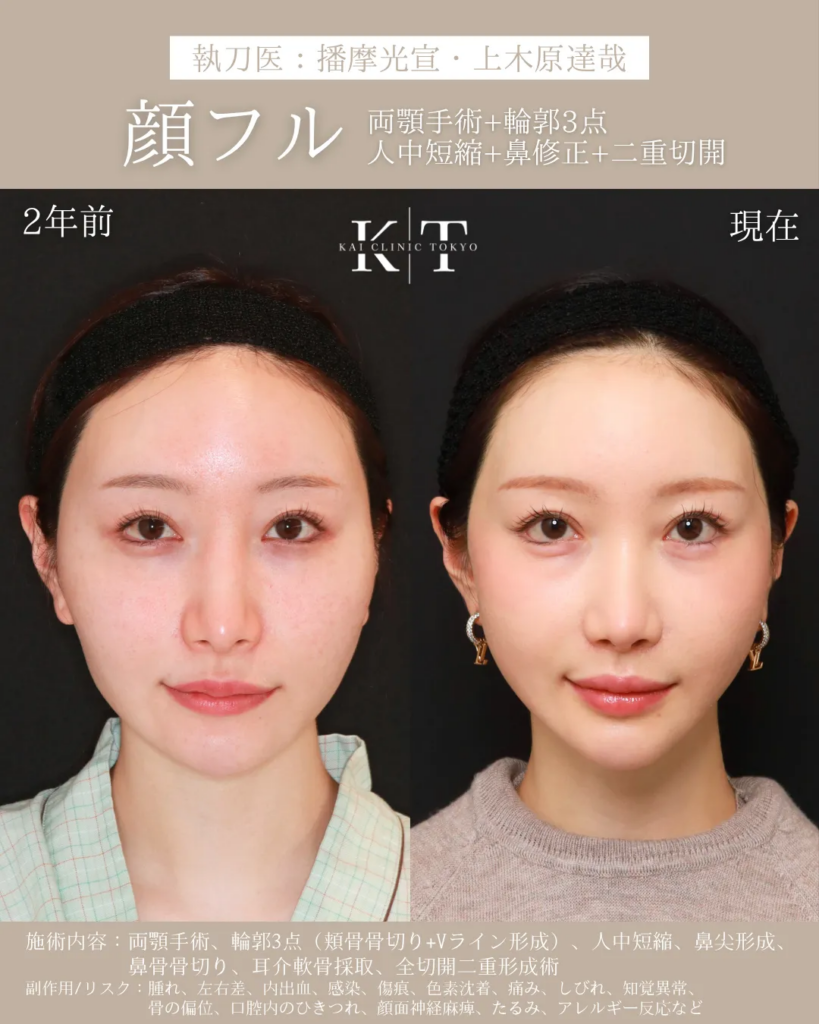
【Surgeon】
Mitsunobu Harima, Tatsuya Uekihara
【Treatment Details】
Bimaxillary surgery: ¥2,970,000 / Facial contouring 3-point: ¥2,530,000 / Philtrum reduction: ¥440,000 / Nose correction (nasal tip plasty: ¥330,000, nasal bone osteotomy: ¥550,000, auricular cartilage harvesting (one side): ¥165,000) / Full incision double eyelid surgery: ¥594,000
【Risks and Side Effects】
Swelling, asymmetry, bruising, infection, scarring, hyperpigmentation, pain, numbness, sensory abnormalities, bone displacement, oral tightness, facial nerve palsy, sagging, allergic reactions, etc.
Nose Deformity Correction Including Crooked Nose
Cases of crooked nose correction surgery and before-and-after photos are introduced on Dr. Takafumi Saito's Instagram, so please take a look.
View crooked nose correction after bimaxillary surgery on InstagramConsult KAI CLINIC TOKYO About Your Crooked Nose Concerns
The appropriate treatment for a crooked nose varies depending on the cause and type. Rather than continuing to worry alone, consulting a specialist first to understand your current condition is the first step toward improvement.
At KAI CLINIC TOKYO, we propose treatment plans tailored to each patient's condition and wishes, based on our knowledge of plastic surgery and surgical techniques.
You can of course choose from multiple options such as nasal bone osteotomy narrowing and crooked nose correction surgery, and we will also carefully share the expected results and explain the risks.
If you are troubled by a complex about your crooked nose and wish to pursue "beauty that is uniquely yours," please feel free to consult our clinic first.
Summary
A crooked nose is difficult to correct on your own due to congenital causes, developmental factors, or trauma, and medical treatment is necessary for fundamental improvement.
At KAI CLINIC TOKYO, based on our knowledge of plastic surgery and extensive experience, we propose treatments tailored to each individual patient, such as nasal bone osteotomy narrowing and crooked nose correction surgery.
"I want to fix my crooked nose and improve my facial balance."
If you have such concerns, please take the first step toward improvement by attending a consultation at our clinic.
Supervisor of this article

Director Mitsunobu Harima
Academic Societies
Japan Society of Plastic and Reconstructive Surgery
Japan Society of Aesthetic Plastic Surgery (JSAPS)
Titles & Qualifications
Japan Society of Plastic and Reconstructive Surgery Certified Specialist
Japan Society of Aesthetic Plastic Surgery (JSAPS) Certified Specialist
Career
-
Graduated from the Faculty of Medicine, The University of Tokyo
-
Nadogaya Hospital, Initial Resident Physician
-
The University of Tokyo Hospital, Department of Plastic & Aesthetic Surgery, Specially Appointed Clinical Physician
-
The University of Tokyo Hospital, Department of Plastic & Aesthetic Surgery, Assistant Professor
-
Kanto Central Hospital, Department of Plastic Surgery
-
Tokyo Metropolitan Police Hospital, Department of Plastic & Aesthetic Surgery
-
Kato Clinic ANNEX, Appointed Director
-
KAI CLINIC TOKYO Appointed Director