



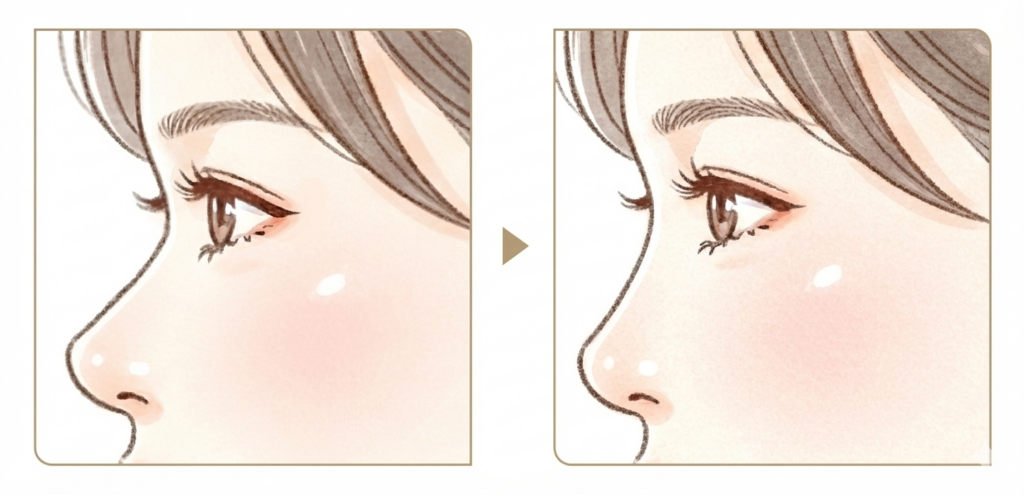
Augmentation rhinoplasty is a procedure used to raise the nose or create a sleek, straight nasal bridge by inserting an implant or autologous tissue. Because the implant or graft is not absorbed by the body, the result is long-lasting.

Recommended for those with these concerns:
- Low nose
- Wanting a sleek, straight nasal bridge
- Eyes that appear far apart because of a low bridge
- A flat-looking midface
Augmentation Rhinoplasty with Autologous Tissue
In this surgical procedure, your own auricular cartilage or costal cartilage is finely diced, inserted, and grafted into the nasal dorsum. Because it uses your own tissue, it carries a low risk of infection or allergic reaction.
Augmentation Rhinoplasty with Implants
In this procedure, a medical-grade silicone implant is placed along the nasal bridge to add height from the nasal root to the dorsum, creating a sharp, defined bridge.
Glabellar Implants
In this procedure, height is added to the nose by inserting an implant from the area between the eyebrows to the base of the nose. It has the effect of improving not only the nose but also the three-dimensional appearance and balance of the entire face. Most patients choose a single implant that runs from the glabella down the nasal bridge. A glabella-only implant is suitable for patients whose bridge already has enough height but whose nasal root or glabella is low.
Procedure Details

1. An incision is made inside the nostril, and the periosteum is elevated to create a pocket.
2. An implant or autologous tissue is inserted into the space under the periosteum and against the nasal bone.
3. The incisions inside the nostrils are sutured.
Augmentation Rhinoplasty with Autologous Tissue
Auricular cartilage is harvested from behind the ear, or costal cartilage from beneath the chest, and cut into fine pieces. An incision is made in the nasal mucosa and the columellar skin, and the diced cartilage is placed along the nasal bridge using the open approach.
Augmentation Rhinoplasty with Implants
An “implant” is made of medical-grade silicone, a material with a long track record of use inside the body. Unlike hyaluronic acid filler, an implant is not absorbed, so the result is long-lasting; it can also be removed or exchanged later if needed.

Recovery and Aftercare
Swelling and Bruising
Swelling and bruising are most noticeable for the first 1–2 weeks after surgery. The nose continues to settle for about 3 months, after which the final shape is visible.
Daily Life
Please refrain from wearing sunglasses or glasses for about 1 week after the surgery to avoid applying strong external force to the nose.
Please make sure to sleep on your back. Please also avoid touching or wetting the surgical site for the first week, or until your doctor tells you it is safe to do so.
Risks and Side Effects
Risks and side effects include swelling, bruising, pain, edema, redness, scarring, and infection.