



Nostril rim lowering is a surgery that makes the nostrils less noticeable by harvesting skin and cartilage from behind the ear and grafting them inside the nostril.
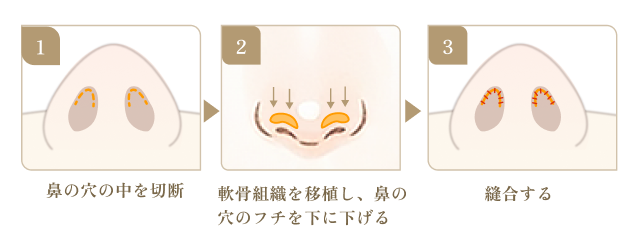
2. The cartilage tissue is grafted to lower the rim of the nostril.
3. The incision is sutured.
Recommended for those with these concerns:
- Width of the nasal alae
- Drooping nasal alae
- Size of the nose
- Size of the nostrils
Procedure Details
An incision of about 3 cm is made behind the ear to harvest cartilage and skin. These are grafted inside the nostril and sutured.
This procedure is employed when the nostrils appear vertically elongated.
Grafting cartilage alone is common; however, if there is not enough skin lining the nostril, a composite graft (cartilage with its attached skin) is used, as shown in the diagram below.
The auricular cartilage and skin are harvested together and grafted inside the nostril to lower the nostril rim.
The grafted ear skin is not visible from the outside, and the procedure is designed so that the skin from inside the nose appears on the outer surface.
If nasal hair grows up to the nostril rim, there is a possibility that the nasal hair may become visible; however, this can be addressed with medical (laser) hair removal of the nasal hair.

Recovery and Aftercare
Swelling and Bruising
Swelling and bruising are most noticeable for the first 1–2 weeks after surgery. The nose continues to settle for about 3 months, after which the final shape is visible.
Daily Life
Please sleep on your back so that no strong external force is applied to the nose.
Please also avoid touching or wetting the surgical site for the first week, or until your doctor tells you it is safe to do so.
Risks and Side Effects
Risks and side effects include swelling, bruising, pain, edema, redness, scarring, infection, and asymmetry.