



A septal extension graft is a procedure in which your own cartilage — usually septal, auricular (ear) or costal (rib) cartilage — is used to lengthen the nasal septum, the central wall that separates the left and right sides of the nose. By extending a short, upturned nasal tip forward and downward, and adjusting its height, direction and length, the procedure refines the overall balance of the face, including the profile (the “E-line”, an imaginary line from the tip of the nose to the chin).
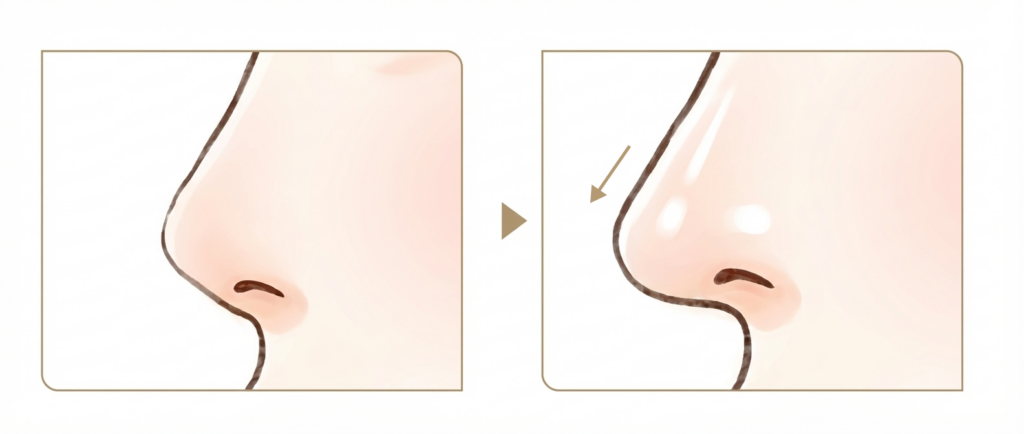
Recommended for those with these concerns:
- Short nose / Desire to add length or height to the nasal tip
- Upturned nose or the nasal tip pointing upward
- Concerned about nostrils being visible or prominent from the front
- Desire to improve the profile or the direction of the nasal tip
About the Procedure

2. The cartilage is sutured to the nasal septal cartilage to extend the nasal septum.
3. Plate-like cartilage is sutured horizontally and secured.
Surgical Techniques for Septal Extension
Different types of surgical techniques and fixation methods are employed for septal extension.
For the method of fixing the added cartilage, there are approaches that place and secure it on only one side next to the nasal septal cartilage, as well as approaches that secure it on both sides.
Please consult with us during your counseling session to determine which surgical procedure is right for you.
Tips: Difference between the septal extension technique and the columellar strut technique
- In septal extension, because the grafted cartilage is directly secured to the nasal septum, which is the central support column of the nose, the position, direction, and height of the nasal tip can be changed significantly and in a stable way (as a result, the nasal tip will feel slightly firm). The columellar strut technique is a method to support the nose by placing a cartilage pillar between the left and right lower lateral cartilages (medial crura); because it is not fixed to the septum, the change is more modest, but it tends to produce a natural, soft nasal tip.
Procedure Details
Septal extension lengthens the nasal tip forward and downward by fixing a cartilage graft to the front (caudal) end of the septal cartilage. A short septal cartilage is one of the main causes of a short or upturned tip. In septal extension, because it is necessary to accurately determine the fixation direction, distance, and position of the grafted cartilage, the procedure is performed using the open approach (incisions made in the columella and inside both nostrils), which allows for operation under direct visualization, to precisely fix the position and orientation of the cartilage.

Recovery and Aftercare
Swelling and Bruising
Swelling and bruising are most noticeable for the first 1–2 weeks after surgery. The nose continues to settle for about 3 months, after which the final shape is visible.
Daily Life
Please sleep on your back so that no strong external force is applied to the nose.
Please also avoid touching or wetting the surgical site for the first week, or until your doctor tells you it is safe to do so.
Risks and Side Effects
Risks and side effects include swelling, bruising, pain, edema, redness, scarring, infection, and asymmetry.
Price
Frequently Asked Questions
Q. Where will the scar be located for the costal cartilage?

Q. Will the tip droop over time (a hooked or “hanging” tip)?
Q. Will the result change as I age?
• Firmly construct and stabilize the structural support layer
• Reinforce both sides of the nasal septal cartilage with cartilage
• Use two pieces of cartilage for reinforcement on each side instead of one