



Hump reduction surgery is a procedure that shaves down the protrusion (hump) at the junction of the nasal bone and cartilage. This procedure refines a prominently arched nasal bridge, creating a smooth, balanced, and beautiful line.
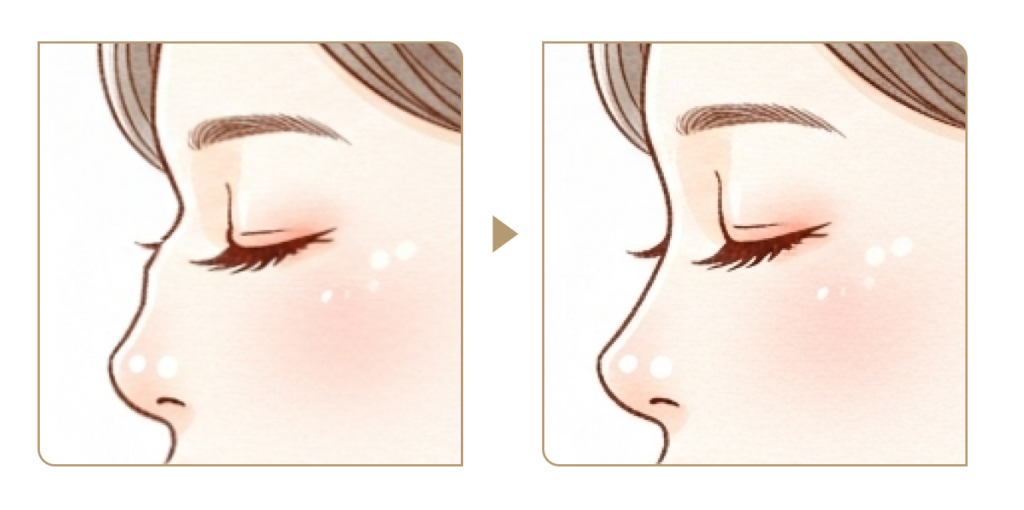
Recommended for those with these concerns:
- Dorsal hump (bump on the bridge)
- Uneven nasal bridge
- Bumpy nose

Center: Bone shaving + augmentation rhinoplasty — The bone is shaved from inside the nostrils, and then an implant or autologous tissue is inserted.
Right: Injection — Hyaluronic acid is injected.
Genetic factors play a significant role; a dorsal hump is thought to form where the nasal bone and cartilage meet and grow at different rates. It is similar to tectonic plates colliding with each other to form a mountain. While bone shaving to shave down the top of the mountain is the main procedure for hump reduction, preservation rhinoplasty has also emerged in recent years. Preservation rhinoplasty, by contrast, is like lowering the whole mountain by cutting at its base.
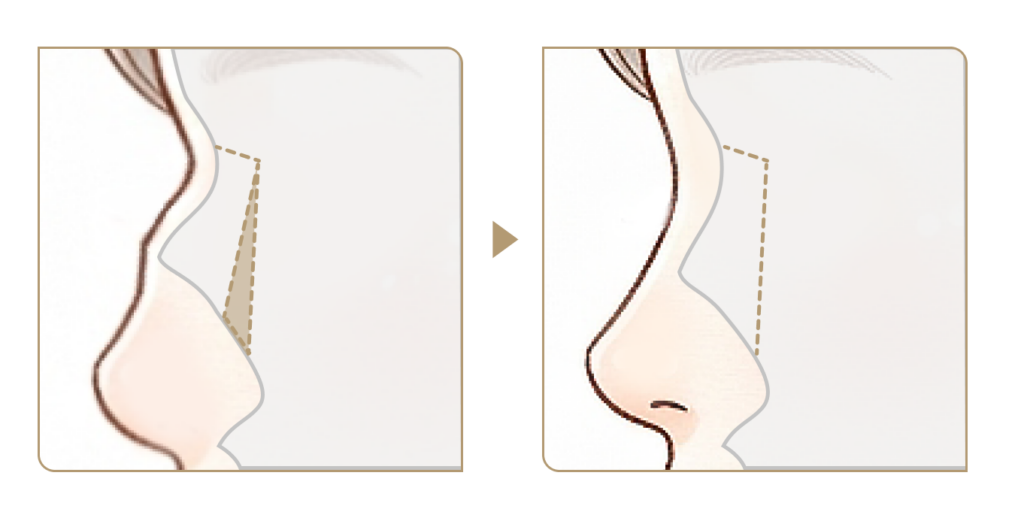
“Preservation” means to conserve, and as the name suggests, it allows the shape to be changed while preserving the nasal structures. It offers the following benefits, and in recent years, preservation rhinoplasty is increasingly being used for deviated nose correction as well.
• The dissection area is small, resulting in less postoperative swelling.
• Nasal function is less likely to be impaired.
• Skin contraction and visible irregularities (steps) in the bridge line are less likely.
Procedure Details
The position of the hump is marked, incisions are made inside both nostrils and to the columella, and the nasal structure is confirmed using the open approach. The cartilaginous hump is removed with a scalpel. The bony hump is shaved down with a rasp. If a large amount of the hump is removed, the nasal bridge may appear wide. Therefore, if necessary, nasal bone osteotomy for width reduction is used in combination with this procedure to refine it into a slim, straight line. Finally, the incisions are sutured and the nose is supported with a nasal splint.

Recovery and Aftercare
Swelling and Bruising
Swelling and bruising are most noticeable for the first 1–2 weeks after surgery. The nose continues to settle for about 3 months, after which the final shape is visible.
Daily Life
Please sleep on your back so that no strong external force is applied to the nose. Please also avoid touching or wetting the surgical site for the first week, or until your doctor tells you it is safe to do so.
Risks and Side Effects
Risks and side effects include swelling, bruising, pain, edema, redness, scarring, and infection.